


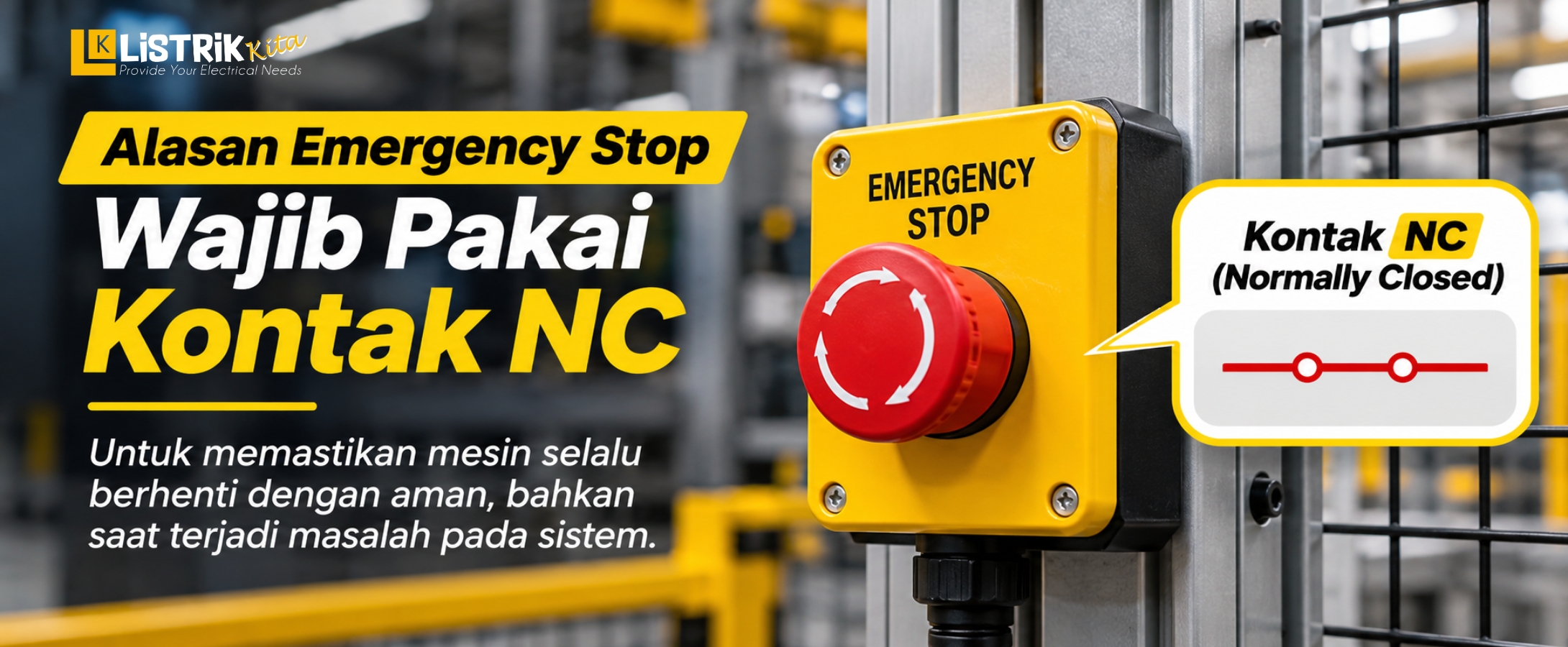
Safety is one of the most important aspects of electrical and industrial automation systems. An emergency stop is designed to stop a machine or equipment quickly when a dangerous situation occurs. Listrik Kita is an official Schneider Electric distributor that provides original and warranty-backed products for various electrical and industrial needs.
One important part of an emergency stop installation is choosing the right contact type. Emergency stop circuits commonly use a Normally Closed (NC) contact because this configuration supports the fail-safe principle. With this setup, the circuit can respond not only when the emergency stop button is pressed, but also when there is a problem with the control circuit.
What Is a Normally Closed Contact in an Emergency Stop?
How Does an NC Contact Work in an Emergency Stop Circuit?
A Normally Closed or NC contact is connected when the device is in its normal position. When the emergency stop button is pressed, the contact changes to an open state and breaks the control circuit.
Once the control circuit is interrupted, the system can send a stop command to the machine. After the emergency situation has been handled, the emergency stop can be returned to its normal position according to the operating procedure.
Why Does an Emergency Stop Use an NC Contact?
The use of an NC contact is closely related to the fail-safe principle. In simple terms, the system is designed so that certain failures or faults lead the equipment toward a safer condition.
In an emergency stop circuit, the control path needs to remain connected during normal operation. If there is a problem with that path, such as a broken wire, the circuit can detect an abnormal condition and stop the machine or prevent it from operating.
1. Detecting Broken Wires or Faults
A Broken Wire Can Be Detected by an NC Circuit
One of the main advantages of an NC contact is that it can help detect problems in the emergency stop circuit. When the button is in its normal position, the circuit needs to remain closed for the system to operate.
If a wire connected to the emergency stop breaks, the circuit becomes open. This condition can be treated as a fault and cause the system to move into a safer state. As a result, a problem in the control circuit is less likely to go unnoticed.
Helping Identify System Faults
This is especially important for machines used in production environments. Damaged wires, loose connections, or other circuit problems can affect the performance of the safety system.
By using an NC contact, faults in the emergency stop circuit can be easier to identify because the system requires circuit continuity during normal operation. This helps improve the overall reliability of the safety system.
2. The Risks of Using Normally Open
An Emergency Signal May Not Be Detected
Unlike NC, a Normally Open or NO contact remains open during normal operation and only closes when the button is activated. If this configuration is used as the main emergency stop circuit, certain faults may be difficult to distinguish from a normal condition.
For example, if the wire becomes disconnected, the system may still see an open circuit. However, that open circuit could actually indicate a fault in the emergency stop system.
The Machine May Continue Operating After a Fault
Failure to detect a fault can become a serious issue in a safety-related application. If the emergency stop circuit is damaged and the system does not recognize the problem, the emergency stop function may not work when it is actually needed.
For this reason, an NC contact is more suitable for an emergency stop circuit that follows the fail-safe principle. The system can monitor circuit continuity and respond when an abnormal condition occurs.
3. Reliability During Critical Situations
The Fail-Safe Principle in an Emergency Stop
An emergency stop needs to remain reliable when unexpected situations occur. The fail-safe principle helps ensure that a fault in the safety circuit does not simply allow the machine to continue running.
With an NC contact, the circuit remains closed during normal operation. When the button is pressed or a fault occurs in the circuit, the contact opens and the system can respond by stopping the machine.
Fast Response When the Emergency Stop Is Pressed
When an operator presses the emergency stop button, the NC contact changes from closed to open. This interrupts the control circuit and can stop the machine through the connected control system.
Fast response is essential during an emergency. The faster the machine receives the stop command, the better the chance of reducing the risk caused by a dangerous situation.
Keeping the System Safe During a Fault
Emergency stop reliability is not only about the button's ability to stop a machine when it is pressed. The system also needs to consider possible failures in wires, connections, or other components.
This is one reason why NC contacts are commonly used in emergency stop circuits. This configuration helps the system recognize a loss of continuity as a condition that needs attention, so the safety function does not depend only on the physical condition of the button.
Using a Normally Closed contact in an emergency stop circuit plays an important role in improving system safety. An NC contact allows the circuit to monitor control path continuity, helps detect broken wires or faults, and supports the fail-safe principle.
In contrast, using Normally Open as the main emergency stop circuit can make faults such as broken wires harder to distinguish from normal conditions. In safety-related systems, the ability to detect failures is extremely important.
If you need a Schneider Electric emergency stop for panels, machines, or automation systems, you can find original and warranty-backed products at Listrik Kita. Choose from a range of electrical and industrial control products to help build a safer and more reliable system.
