


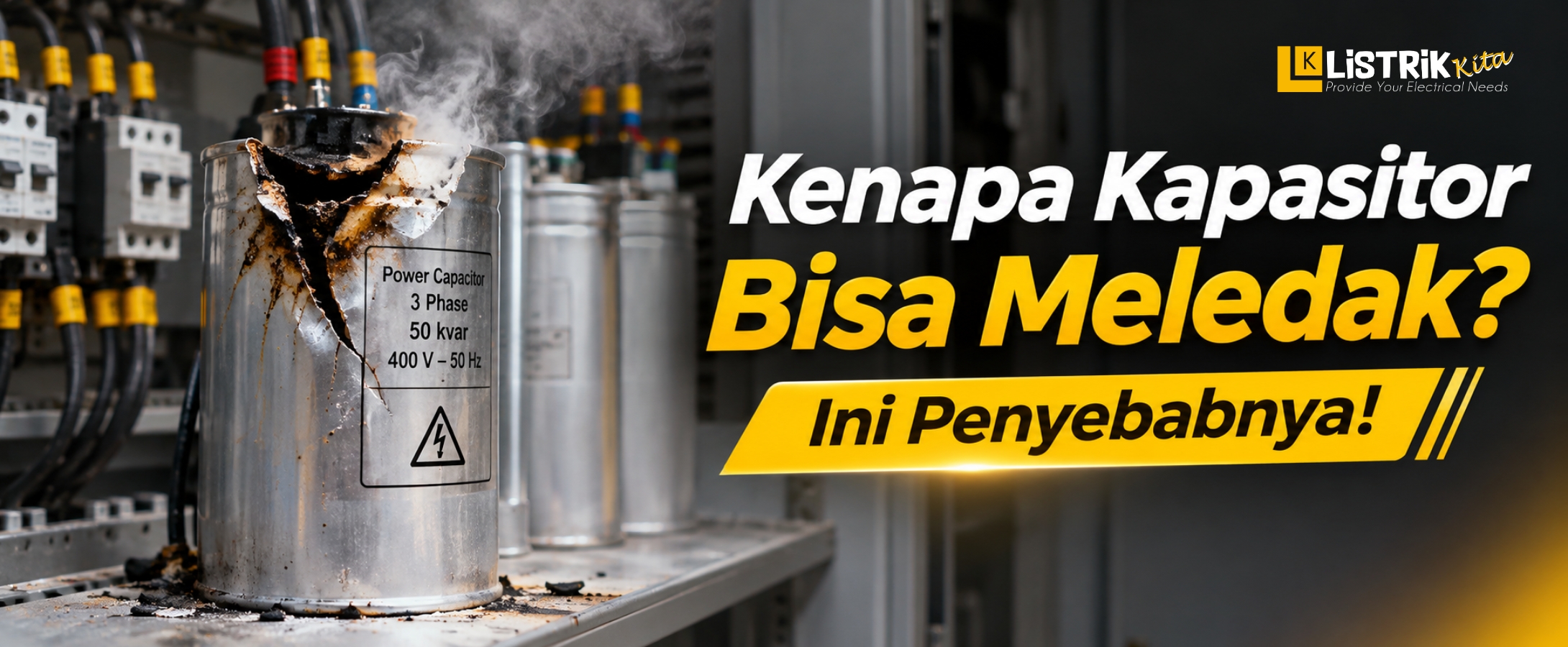
Capacitors are important components used in many electrical and electronic systems. They can store electrical energy, help stabilize voltage, improve power factor, and support the operation of electric motors. However, like other electrical components, capacitors can also fail. In some cases, a damaged capacitor may swell, leak, or even explode. Listrik Kita is an official Schneider Electric distributor that provides original and warranted products for various electrical needs, including capacitors for suitable applications.
So, why can a capacitor explode? This usually happens when a capacitor operates outside its specifications or develops an internal fault. Here are some common causes that you should know.
1. Excessive Voltage (Overvoltage)
One of the main causes of capacitor failure is voltage that exceeds its rated limit. Every capacitor has a maximum voltage rating that indicates the highest voltage it can safely handle.
When a capacitor continuously receives voltage above its rating, its insulation layer or dielectric material can become damaged. This can increase leakage current and generate heat inside the capacitor. If the condition continues, the damage can become more serious and may eventually cause the capacitor to rupture or explode.
For this reason, the capacitor's voltage rating should always be considered based on the actual operating voltage of the system.
2. Reversed Polarity
Incorrect polarity is another important factor, especially for electrolytic capacitors that have positive and negative terminals.
If a polarized capacitor is installed in the wrong direction, it can cause high leakage current and increase the internal temperature. Gas may also build up inside the component, increasing internal pressure. If the problem is not addressed, the capacitor may swell, leak, or even rupture.
Before installing a capacitor, always make sure that the positive and negative terminals match the circuit correctly.
3. Excessive Current (Overcurrent)
Voltage is not the only factor that can damage a capacitor. Excessive current can also affect its condition. High current can increase the amount of heat generated inside the component, especially when the capacitor operates outside its intended specifications.
Continuous heating can damage the internal materials and reduce the capacitor's performance. Over time, this may accelerate component failure and increase the risk of a serious fault.
Therefore, the capacitor should be selected according to the application, including its ability to handle the expected current and operating conditions.
4. Excessive Heat (Overheating)
Temperature plays an important role in capacitor performance and service life. High ambient temperatures, poor ventilation, or heat from nearby components can cause a capacitor to operate at excessive temperatures.
Continuous exposure to high temperatures can accelerate the deterioration of the internal materials. In certain conditions, the pressure inside the capacitor may also increase, which can cause it to swell, leak, or rupture.
Make sure the capacitor is installed in an environment with suitable temperature conditions and adequate airflow.
5. Incorrect Capacitor Voltage Rating
Choosing a capacitor with an unsuitable voltage rating can also create problems. One condition that should be avoided is using a capacitor with a voltage rating that is too low for the system's operating voltage.
For example, if a circuit operates at a certain voltage, the capacitor should have a suitable voltage rating that can safely handle that condition. Using a component with an insufficient voltage rating can place excessive electrical stress on the capacitor and increase the risk of failure.
Besides voltage rating, capacitance, operating temperature, frequency, and other specifications should also match the application.
6. Poor Quality or Manufacturing Defects
Not every capacitor failure is caused by incorrect installation or system conditions. Product quality can also be a factor. Capacitors made with poor materials or affected by manufacturing defects may have lower performance and a higher risk of failure.
Problems with production processes, dielectric materials, internal construction, or quality control can affect how well a capacitor performs over time.
Choosing products from trusted manufacturers and reliable distributors can therefore help reduce the risk of using components that do not meet the required standards.
7. Component Aging
Capacitors also have a service life. After operating for a long period, their internal characteristics can change and their performance may gradually decrease.
In some types of capacitors, aging can increase ESR, change the capacitance value, and increase heat during operation. If these conditions are ignored, an old capacitor may eventually fail.
Regular inspection can help identify early signs of deterioration before the problem affects the entire electrical system.
What Happens When a Capacitor Starts to Fail?
Before a capacitor actually ruptures, there may be several warning signs. The capacitor may become swollen, leak, change shape, produce an unusual smell, or become hotter than normal.
In certain situations, an internal failure can generate gas and increase the pressure inside the component. Some capacitors have safety mechanisms designed to respond to excessive internal pressure, but a capacitor that already shows signs of damage should still be inspected and handled properly.
How Can You Prevent a Capacitor From Exploding?
The risk of capacitor failure can be reduced by selecting a product that matches the application. Check the voltage rating, capacitance, operating temperature, frequency, and other specifications to make sure they are suitable for the system.
Proper installation is also important, especially for capacitors with polarity. The surrounding environment should also be considered so the capacitor does not operate continuously at excessive temperatures.
Regular inspection is another important step. If you notice swelling, leakage, excessive heat, or other physical changes, inspect the capacitor before putting it back into operation.
Choosing the right capacitor is not only about its capacitance value. Voltage rating, operating conditions, product quality, and application requirements should also be considered. Using the right product can help maintain the performance and reliability of an electrical system.
If you are looking for original and warranted Schneider Electric capacitors, you can purchase them through Listrik Kita. As an official Schneider Electric distributor, Listrik Kita provides Schneider Electric products for residential, commercial, industrial, and project applications. Choose the Schneider Electric capacitor that fits your needs and get original products with reliable service from Listrik Kita.
