


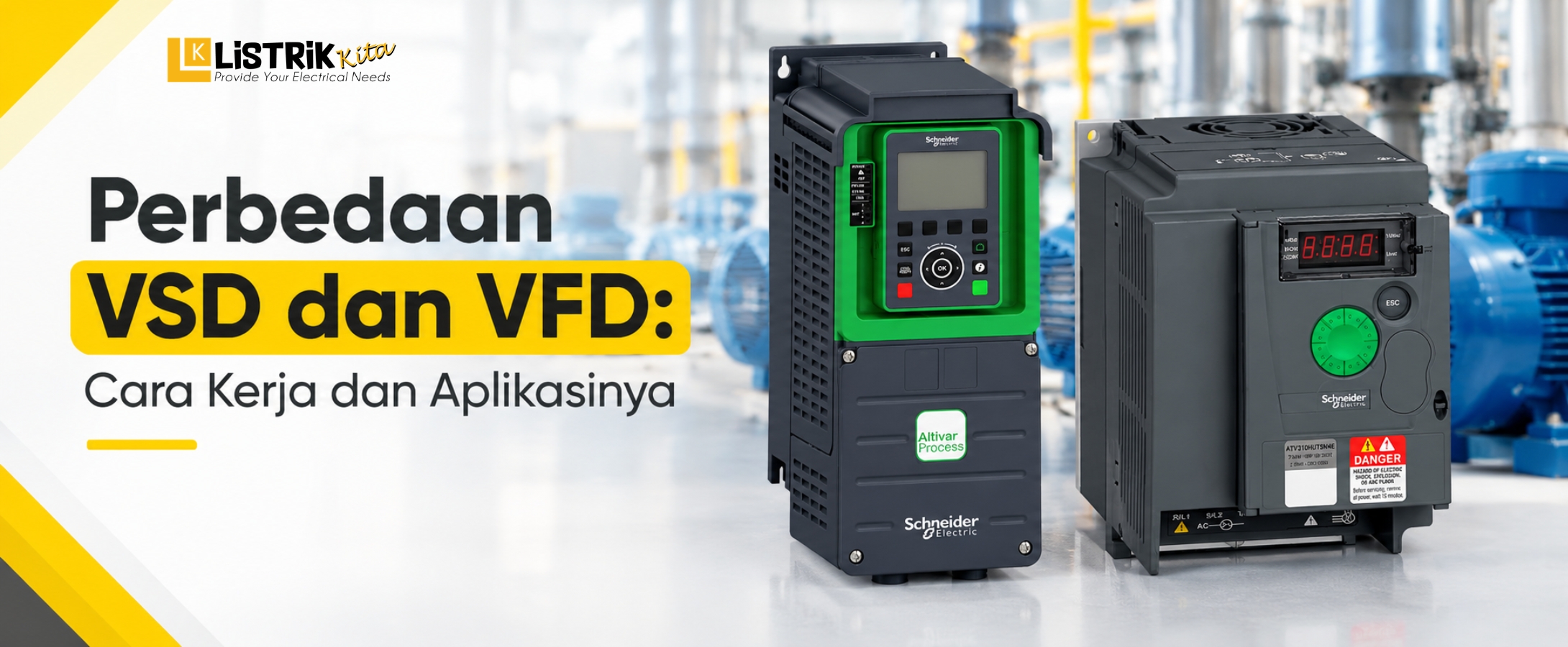
In industrial systems, controlling the speed of an electric motor is important for keeping operations efficient and reliable. Two technologies commonly used for this purpose are Variable Speed Drive (VSD) and Variable Frequency Drive (VFD). Although these terms are often used interchangeably, they have different meanings and scopes. Listrik Kita is an official Schneider Electric distributor that provides original and warranted products for various electrical needs, including motor speed control equipment.
What Are VSD and VFD?
Definition of VSD
VSD, or Variable Speed Drive, is a device used to control the speed of a motor based on the needs of a system. This means the motor does not always have to run at maximum speed when the required load is lower.
The term VSD has a broad meaning because it can refer to different technologies used to control motor speed. Depending on the type of drive, motor speed can be controlled by changing frequency, voltage, or other electrical parameters.
Definition of VFD
VFD, or Variable Frequency Drive, is a type of drive that controls motor speed by changing the frequency and voltage supplied to the motor. VFDs are widely used with AC motors, especially in industrial applications that require flexible speed control.
Simply put, when the frequency increases within the motor's operating limits, the motor speed generally increases as well. When the frequency decreases, the motor speed also decreases.
Are VSD and VFD the Same?
VSD and VFD have a similar purpose, which is controlling motor speed. However, VSD is a broader term, while VFD refers to a specific type of variable speed drive technology.
Since VFDs are widely used for AC motor control, the terms VSD and VFD are sometimes used to describe the same type of equipment in everyday conversations.
How Do VSD and VFD Work?
How VSD Works
The operating principle of a VSD depends on the technology used to control the motor. The drive adjusts the motor's electrical parameters according to system requirements so the motor can run at the desired speed.
This flexible speed control allows the motor to operate according to actual demand instead of constantly running at maximum speed. In some applications, this can improve system efficiency and reduce mechanical stress.
How VFD Works
A VFD controls motor speed by changing the frequency of the electrical power supplied to the motor. In general, AC power from the source is first converted into DC through a rectifier. The DC power is then processed by an inverter, which produces AC power again with controlled frequency and voltage.
Changing the frequency allows the VFD to control the motor's rotational speed. Because the VFD can also control acceleration and deceleration, it can help reduce sudden mechanical stress when the motor starts or stops.
Difference Between VSD and VFD Operation
The main difference is related to the terminology and technology. VSD is a general term for systems used to control motor speed, while VFD specifically uses frequency control as a main method for controlling an AC motor.
In simple terms, a VFD can be considered one common type of VSD used for AC motors.
VSD and VFD Applications in Different Industries
VSD Applications
VSDs can be used in systems that require variable motor speed, including pumps, fans, blowers, conveyors, production machines, and HVAC systems. The drive allows the motor speed to match the actual requirements of the system.
VFD Applications
VFDs are widely used for water pumps, conveyors, compressors, fans, blowers, HVAC systems, and various production machines. For example, in a pumping system, motor speed can be adjusted according to the required flow instead of keeping the motor at full speed all the time.
In conveyor systems, a VFD can control the motor speed based on the production process and material handling requirements.
Factors to Consider
Before choosing a VSD or VFD, several factors should be considered. These include motor type and capacity, load characteristics, required speed range, control method, environmental conditions, and energy efficiency requirements.
Choosing the right drive helps the motor system operate more effectively and avoids using equipment that does not match the motor or application.
Benefits of VSD and VFD
Benefits of VSD
VSDs can provide several benefits when a system requires regular changes in motor speed. The motor can operate according to actual demand, which may improve energy efficiency in certain applications.
Gradual speed control can also help reduce mechanical stress during motor starting and speed changes.
Benefits of VFD
VFDs provide flexible and precise motor speed control. They can also support soft starting and stopping, allowing the motor to accelerate and decelerate more gradually.
In certain applications, using a VFD can reduce energy consumption, especially in systems with changing loads such as pumps and fans.
Examples of VSD and VFD Applications
VSD in Pumping Systems
In a pumping system, a VSD can adjust motor speed based on the required flow. When less flow is needed, the motor speed can be reduced so the system does not have to operate at maximum capacity.
VFD in Conveyor Systems
A VFD can be used in conveyor systems to control material movement speed. The motor speed can be adjusted according to production requirements and the desired process flow.
VFD in HVAC Systems
In HVAC systems, a VFD can control fan or motor speed according to cooling demand. When the cooling requirement changes, the motor speed can be adjusted to help the system operate more efficiently.
VSD and VFD are both used to control motor speed, but the terms have different scopes. VSD is a broader term for variable speed drive technology, while VFD is a specific type of drive that controls motor speed by changing electrical frequency and voltage.
The right drive should be selected based on the motor type, load characteristics, control requirements, and application conditions. If you are looking for a variable speed drive for industrial applications, Listrik Kita provides Schneider Electric variable speed drives with original products and warranty. Explore Schneider Electric variable speed drive options at Listrik Kita for your application needs.
