


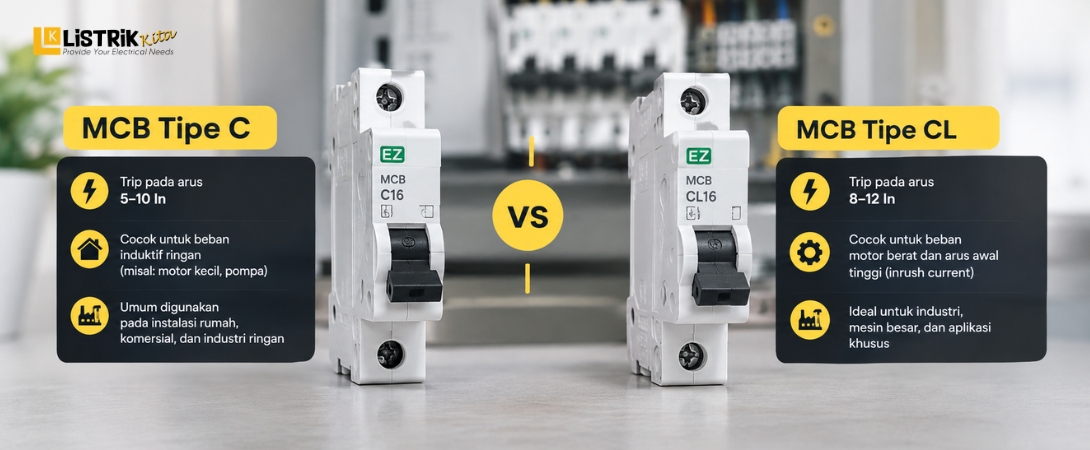
MCB, or Miniature Circuit Breaker, is an important protection device in electrical installations. It helps protect electrical circuits from excessive current that can cause overheating, equipment damage, and even fire hazards. However, MCBs come with different trip characteristics, so choosing the right one depends on the load and installation requirements.
Two characteristics that are often compared are Type C MCB and CL, or Current Limiting, MCBs. Both provide protection against excessive current, but their response characteristics and applications can be different. Understanding the difference between Type C and CL MCBs can help you choose the right protection for your electrical system.
What Is a Type C MCB?
A Type C MCB is designed for circuits where the load can produce a relatively high starting current. This characteristic makes Type C MCBs suitable for applications where motors or other equipment may draw higher current when starting.
Type C MCB Trip Curve
For Type C characteristics, the magnetic trip generally operates when the current reaches around 5 to 10 times the MCB's rated current (In). The thermal trip, on the other hand, operates more slowly during an overload condition.
The trip curve shows the relationship between the current flowing through the MCB and the time required for the MCB to disconnect the circuit. As the fault current increases, the trip response generally becomes faster.
Type C MCB Sensitivity
A Type C MCB does not immediately disconnect the circuit because of every short current increase within its operating range. This makes it suitable for loads that require a higher starting current when they begin operating.
Type C MCB Applications
Type C MCBs are commonly used in circuits with inductive loads or equipment that has a relatively high starting current. Examples include electric motors, pumps, compressors, transformers, and various commercial or industrial applications.
What Is a CL (Current Limiting) MCB?
CL, or Current Limiting, refers to a protection characteristic that limits the current or energy allowed to pass through the circuit during a fault. The main purpose is to reduce the energy delivered to the electrical system during a short circuit.
Current limiting should not automatically be treated as the same thing as B, C, or D trip curves. Its actual performance can vary depending on the product design, series, and applicable standards.
CL MCB Trip Curve
The curve of a current-limiting device shows how quickly the MCB responds to a fault and limits the energy passed into the system. During a short circuit, rapid interruption can help reduce thermal and electromagnetic stress on cables and other components.
For this reason, the trip curve and current-limiting data in the manufacturer's datasheet should be checked when selecting a CL device.
CL MCB Sensitivity
The sensitivity of a current-limiting MCB relates to how quickly it responds to an overcurrent or short-circuit condition. However, sensitivity cannot be determined from the CL label alone. The actual response should be checked using the specifications and trip curve of the specific product.
CL MCB Applications
Current-limiting characteristics can be useful in installations where reducing the energy caused by short-circuit faults is important. Selection should consider rated current, prospective short-circuit current, breaking capacity, load characteristics, and coordination with other protection devices.
Difference Between Type C and CL MCB
Aspect | Type C MCB | Current-Limiting MCB |
| Characteristic | Type C trip curve | Focuses on limiting fault current or energy |
| Response | Suitable for loads with certain starting currents | Designed to reduce the impact of fault current |
| Sensitivity | Magnetic trip generally around 5 to 10 × In | Depends on the product design and specifications |
| Applications | Motors, pumps, compressors, and inductive loads | Installations requiring short-circuit energy limitation |
| Selection basis | Trip curve and load characteristics | Trip curve, breaking capacity, and current-limiting data |
How to Read an MCB Time-Current Curve?
An MCB time-current curve shows when the device is expected to disconnect the circuit based on the amount of current flowing through it.
Understanding the Axes on an MCB Trip Curve
The horizontal axis usually shows the current as a multiple of the MCB's rated current, such as 1×In, 2×In, or 10×In. The vertical axis shows the trip time, usually measured in seconds.
Both axes are commonly displayed using logarithmic scales. This means the distance between values does not represent the same linear increase as it would on a standard graph.
Understanding the Trip Curve Areas
An MCB curve generally includes thermal and magnetic operating areas. The thermal area relates to overload conditions that continue for a certain period. The greater the overload, the faster the MCB will generally trip.
The magnetic trip responds to much higher fault currents and operates within a very short period.
Example of Reading an MCB Curve
For example, imagine an MCB with a rated current of 10 A. If the current flowing through the MCB reaches 20 A, the current is equal to 2×In. From this point, you can read the curve to estimate the time range before the MCB trips.
If the current rises much higher, such as several times the rated current, the magnetic trip may operate much faster. This is why understanding an MCB trip curve is important instead of choosing an MCB based only on its ampere rating.
Type C vs CL MCB: Which One Should You Choose?
Factors to Consider Before Choosing an MCB
MCB selection should not be based only on rated current. Load type, starting current, installation characteristics, prospective short-circuit current, breaking capacity, and coordination with other protection devices should also be considered.
For a Type C MCB, the load characteristic is important because it can be suitable for loads with certain starting currents. For a current-limiting device, its fault energy limitation capability and technical data should be carefully reviewed.
Common Mistakes When Choosing an MCB
One common mistake is choosing an MCB only by its ampere rating without considering the load characteristics. Another mistake is assuming that every MCB has the same trip curve.
Always check the product specifications, trip curve, breaking capacity, and installation requirements before selecting an MCB.
Type C MCBs and current-limiting devices have different protection focuses. Type C MCBs have a trip characteristic that can suit various loads with higher starting currents, while current-limiting devices focus on reducing fault current and energy during abnormal conditions.
Understanding how to read an MCB time-current curve makes it easier to understand how the device responds to overload and short circuits. Choosing the right MCB can provide protection that is better suited to the needs of the electrical installation.
If you are looking for an MCB for residential, commercial, or other electrical installations, Listrik Kita provides a wide range of electrical products from trusted brands. Listrik Kita is an official Schneider Electric distributor, offering original products with warranty. Find and buy the right MCB for your electrical needs at Listrik Kita.
