


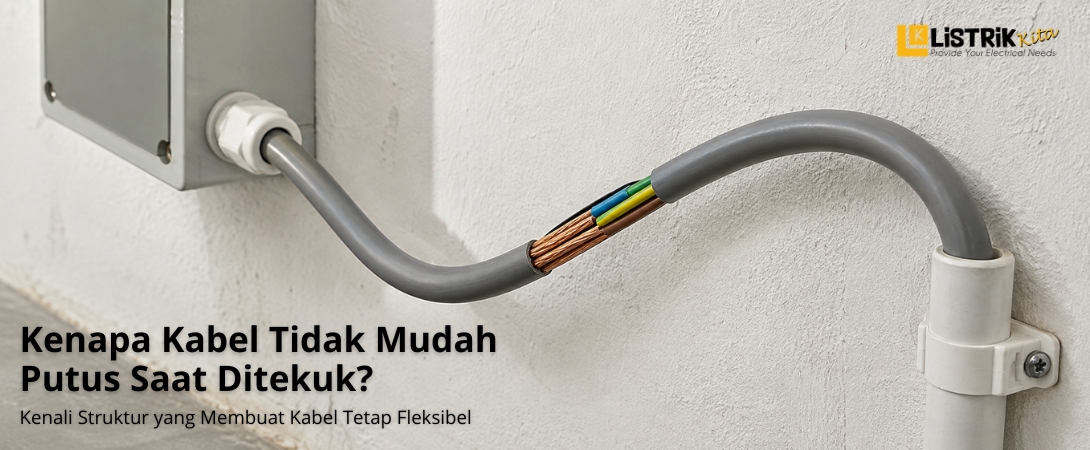
Electrical cables are often bent to follow a certain path during installation. You can find this in homes, buildings, offices, and industrial areas. Even when a cable is bent, it does not immediately break. This does not mean that every cable can be bent as much as you want. There is a technical reason why cables can follow certain curves, mainly because of their conductor construction and insulation materials.
Understanding why cables can bend is important for proper cable selection and installation. Excessive bending or repeatedly bending the same part of a cable can affect the components inside it. In some cases, the damage may not be visible from the outside.
Why Can Electrical Cables Bend Without Breaking?
Cable Flexibility Comes from the Conductor Structure
One of the main reasons a cable can bend is its conductor construction. Some cables do not use one solid piece of metal as the conductor. Instead, the conductor is made of many small metal strands combined into one.
These strands can move slightly when the cable is bent. This is why stranded cables are generally more flexible than cables with a solid conductor. This flexibility is useful when a cable needs to follow a certain route during installation.
However, not every cable has the same level of flexibility. The number of strands, conductor size, cable construction, and materials all affect how easily a cable can bend.
The Insulation Layer Also Helps the Cable Bend
The insulation around the conductor also affects cable flexibility. Its main purpose is to protect the conductor from direct contact with the surrounding environment and other conductors.
Materials such as PVC, rubber, and other insulation materials have different characteristics. Some cables are designed to be more flexible and can handle applications that require more movement. Others are mainly intended for fixed installations.
So, cable flexibility is not determined only by the copper inside. The entire cable construction, from the conductor to the protective layers, affects how well the cable can handle bending.
Is a Bent Cable Always Safe?
Bending Is Different from Sharp Bending
A cable that follows a smooth curve is not necessarily a problem. The concern starts when the cable is forced into a very sharp angle. This type of bending can put extra stress on both the conductor and insulation.
The situation becomes more important when the cable is bent repeatedly. Even if the outer surface still looks normal, the conductor strands inside can gradually experience stress and damage.
Pay Attention to the Minimum Bending Radius
Every cable has a bending limit, which is commonly described as the minimum bending radius. This value indicates how small the cable's curve can be based on its construction.
The limit is not the same for every type of cable. Therefore, installation should follow the manufacturer's specifications. Ignoring the recommended bending radius can shorten cable life and increase the chance of damage.
What Happens If the Conductor Inside the Cable Is Damaged?
Conductor Strands Can Break Gradually
Cable damage caused by bending does not always result in the entire cable breaking immediately. In a stranded conductor, some strands can become damaged first when the cable is bent or pulled too much.
The cable may still look fine from the outside, but its internal condition may already have changed. If the stress continues, more conductor strands can become damaged.
Electrical Resistance Can Increase
When some conductor strands are damaged, there may be less material available to carry the electrical current. This can affect the electrical resistance of the damaged section.
If the cable is used to carry a certain electrical load, the condition of the conductor should be considered carefully. Continued use of a damaged cable can reduce its performance and may cause excessive heat under certain conditions.
The Cable May Overheat
A damaged conductor may no longer distribute current as effectively as it should. If the cable continues to operate in this condition, heat can develop in certain areas.
Repeated exposure to heat can also accelerate the deterioration of the insulation. For this reason, a cable that has changed shape, has damaged insulation, or shows signs of excessive heat should be inspected and should not be forced to continue operating.
Why Does Every Cable Have a Bending Limit?
Cable Construction and Size Are Different
Installation cables, flexible cables, control cables, and power cables can have different constructions. The number of conductor strands, conductor size, insulation thickness, and protective layers can all affect bending performance.
Because their characteristics are different, not every cable should be handled in the same way. A cable designed for fixed installation may not be suitable for applications that require constant movement.
Repeated Bending Can Cause Fatigue
Bending the same section of a cable repeatedly can cause material fatigue. Over time, this can reduce the condition of the conductor strands and protective layers.
The risk can become greater when the cable is bent too sharply or repeatedly moved in a way that does not match its intended design.
Bending Limits Help Extend Cable Life
Bending limits are specified for a reason. Following the recommended bending radius helps reduce excessive stress on the conductor and insulation.
Proper installation allows the cable to perform more reliably and can help extend its service life. For this reason, always check the cable's technical specifications before installation.
How to Bend an Electrical Cable Correctly?
Avoid Forcing the Cable into a Sharp Bend
When installing a cable, avoid creating a very sharp angle just to make it follow a specific route. Give the cable enough space to form a natural curve.
Choose the Right Cable for the Installation
Cable selection should match the application. If an installation requires frequent movement or repeated bending, choose a cable specifically designed for that type of use.
Check the Cable After Installation
After installation, check whether any part of the cable is pinched, twisted, sharply bent, or showing signs of insulation damage. A simple inspection can help identify problems before they develop into more serious electrical issues.
A quality cable that matches the installation requirements can help keep an electrical system reliable. If you are looking for quality electrical cables for residential, commercial, or industrial applications, you can find various options at Listrik Kita. Choose a cable based on the required specifications and application to support safer and more reliable installation.
