


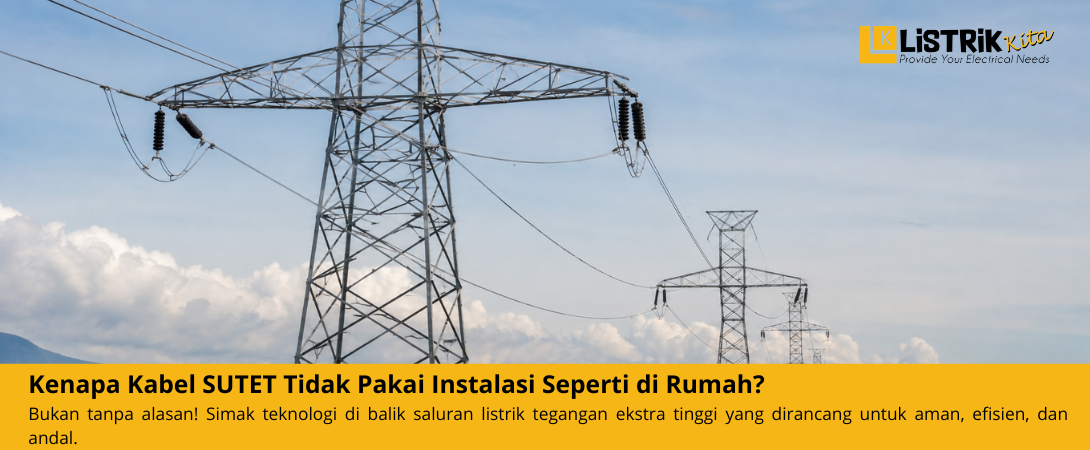
Many people wonder why high voltage transmission lines do not have the same protective insulation as electrical wires used in homes. This question often comes up because these power lines carry extremely high voltages, sometimes reaching hundreds of thousands of volts. Even without visible insulation, the system is designed to operate safely through strict engineering standards. To understand why, it is important to know the difference between transmission and distribution lines, as well as how high voltage transmission systems are built to keep people safe.
Transmission Lines vs Distribution Lines: Different Purposes
Transmission Lines (SUTET / SUTT)
Transmission lines are responsible for carrying electricity over long distances from power plants to substations. Since electricity needs to travel efficiently across cities and regions, these lines operate at very high voltages, such as 70 kV, 150 kV, 275 kV, or even 500 kV.
To maintain safety, transmission lines are installed on tall steel towers that keep the conductors far above the ground and away from nearby structures. This design reduces the risk of accidental contact while ensuring reliable power delivery.
Distribution Lines
Once electricity reaches a substation, it is delivered to homes, offices, and commercial buildings through distribution lines. These cables may be installed on utility poles along the road or placed underground, depending on the area.
Distribution lines operate at much lower voltages than transmission lines. Because they are located closer to people and buildings, many distribution cables are covered with insulation to provide additional protection against accidental contact and environmental exposure.
Why Don't Transmission Lines Have Insulation?
Air Works as a Natural Insulator
One of the main reasons transmission lines do not require plastic insulation is that air itself acts as an effective electrical insulator when proper clearance is maintained. Engineers carefully calculate the distance between conductors and between the conductors and the ground.
As long as these safety clearances are maintained, electricity remains on the conductor instead of jumping to nearby objects. This means the system relies on proper spacing rather than thick insulation.
Thick Insulation Would Make the Cables Too Heavy
Some people assume transmission lines are left uninsulated simply to reduce costs. In reality, insulating cables that carry extremely high voltages would require a very thick protective layer.
This would add significant weight to each conductor, requiring stronger towers and increasing installation and maintenance costs. Using air as the primary insulating medium is a far more practical and efficient engineering solution.
The Insulators Are Installed on the Towers
Although the conductors themselves are not covered with plastic, transmission systems still use insulators. These components are installed where the conductors connect to the transmission towers.
Usually made from porcelain or composite materials, these insulators prevent electricity from flowing into the steel tower. As a result, the electrical current stays on the conductor where it belongs.
Why Don't High Voltage Power Lines Shock People Below?
Safe Clearance Is Carefully Maintained
The height of transmission lines is designed according to strict safety standards. The conductors are placed high enough above the ground to keep people at a safe distance during normal daily activities.
Although electric fields exist around high voltage lines, simply standing underneath them does not mean a person will receive an electric shock. The system is designed to remain safe as long as the required clearance is maintained.
The Danger Comes from Getting Too Close
This does not mean transmission lines should ever be approached. At very high voltages, electricity can travel through the air under certain conditions. This phenomenon is known as an electric arc or arc flash.
The danger typically arises when cranes, metal ladders, or other tall equipment come too close to the transmission lines. That is why safety regulations require people and equipment to maintain a safe distance from transmission lines at all times.
Why Do Distribution Lines Use Insulation?
Distribution lines are installed much closer to homes, offices, schools, and public areas. Since the chance of contact with people, trees, or buildings is much higher, insulation provides an additional layer of protection.
However, not every distribution line is fully insulated. Some medium voltage overhead lines still use bare conductors, but they are installed with proper insulators and safe spacing according to electrical safety standards.
The safety of high voltage transmission lines does not depend on plastic insulation. Instead, it comes from proper spacing, air acting as an insulator, tower-mounted insulators, and carefully planned engineering practices. The safety of the network depends on the complete system rather than insulation wrapped around the conductor itself.
If you are looking for reliable electrical products for homes, commercial buildings, or industrial projects, choose high quality products from Listrik Kita. From electrical cables and circuit breakers to switches, sockets, and installation accessories, you can find trusted products that help keep every electrical installation safe and dependable.
