


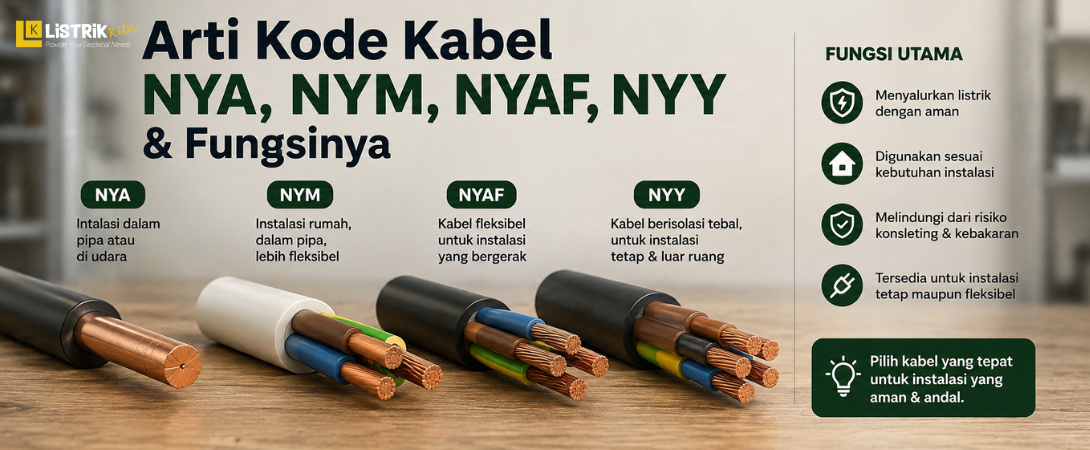
When buying electrical cables, you may notice codes such as NYA, NYM, NYAF, NYMHY, or NYY printed on the cable jacket. At first glance, these combinations of letters may seem confusing. In fact, each code provides important information about the cable's construction, insulation, and intended application.
Understanding electrical cable codes helps you select the right cable for your installation. Choosing the wrong type may reduce performance, shorten the cable's lifespan, and even increase electrical safety risks. Here's an easy guide to reading cable codes and understanding the differences between common cable types.
Why Do Electrical Cables Use Codes?
Cable codes serve as an identification system that explains the cable's specifications and characteristics. By reading the code, electricians and users can identify the conductor type, insulation material, number of cores, and recommended applications.
This standardized naming system makes it much easier to select the correct cable. Instead of cutting the cable open, you can simply read the information printed on the outer jacket.
Cable codes also help ensure that the selected cable matches installation requirements, making electrical systems safer and more reliable.
How to Read Electrical Cable Codes
Each letter in a cable code has a specific meaning.
The letter N indicates that the cable follows the applicable manufacturing standard.
The letter Y means the cable uses PVC (Polyvinyl Chloride) insulation.
The letter A indicates a solid single-core conductor.
The letter F means the conductor is made of fine stranded wires, making the cable more flexible.
The letters HY indicate a highly flexible cable that is suitable for applications where the cable moves frequently.
Besides the letters, cables also display information such as 3×2.5 mm². The first number shows the number of cores, while the second number indicates the cross-sectional area of each conductor. For example, NYM 3×2.5 mm² means the cable has three cores, each with a cross-sectional area of 2.5 mm².
Differences Between NYA, NYM, NYAF, NYMHY, NYY, and NYYHY Cables
NYA Cable
NYA cable has a single solid conductor with PVC insulation. It is commonly installed inside conduits or electrical pipes for residential wiring. Its main advantages are affordability and simple installation. However, because it only has one insulation layer, it should not be installed without additional protection.
NYM Cable
NYM cable contains two or more conductors and features double insulation for improved safety. It is widely used in residential and commercial buildings because it offers better mechanical protection than NYA cable.
NYAF Cable
NYAF cable uses fine stranded conductors, making it highly flexible.
It is commonly installed in electrical panels, control systems, and machinery where flexible wiring is required.
NYMHY Cable
NYMHY is a flexible multi-core cable often used for household appliances and electronic equipment.
Its flexibility makes installation easier in devices where cables may bend repeatedly.
NYY Cable
NYY cable has thicker insulation, providing better protection against moisture and outdoor conditions.
It is commonly used for outdoor installations or underground wiring with proper protection.
NYYHY Cable
NYYHY combines stranded conductors with durable insulation.
It is suitable for applications that require both flexibility and good environmental protection.
Examples of Reading Cable Codes
For example, NYA 1×2.5 mm² means the cable has one conductor with a cross-sectional area of 2.5 mm².
NYM 2×1.5 mm² indicates two conductors, each measuring 1.5 mm².
Meanwhile, NYY 4×10 mm² represents a four-core cable with 10 mm² conductors designed for higher power applications.
Most cable jackets also include the brand name, cable size, rated voltage, and manufacturing standard, helping users verify the cable before installation.
Can Every Cable Be Used for the Same Application?
The answer is no.
Every cable is designed for specific installation conditions. For example, NYA cable is intended for installations inside conduits, while NYY cable is better suited for outdoor environments.
Using the wrong cable can damage the insulation more quickly, reduce installation reliability, and increase electrical hazards.
Before selecting a cable, consider the installation location, current capacity, environmental conditions, and the equipment being connected.
Knowing how to read electrical cable codes makes it much easier to choose the right cable for any installation. Whether it is NYA, NYM, NYAF, NYMHY, NYY, or NYYHY, each cable has its own design and purpose.
If you are looking for genuine, high-quality electrical cables for residential, commercial, or industrial projects, explore the complete range available at Listrik Kita. Choosing the right cable from a trusted supplier helps ensure a safer, more reliable, and longer-lasting electrical installation.
