


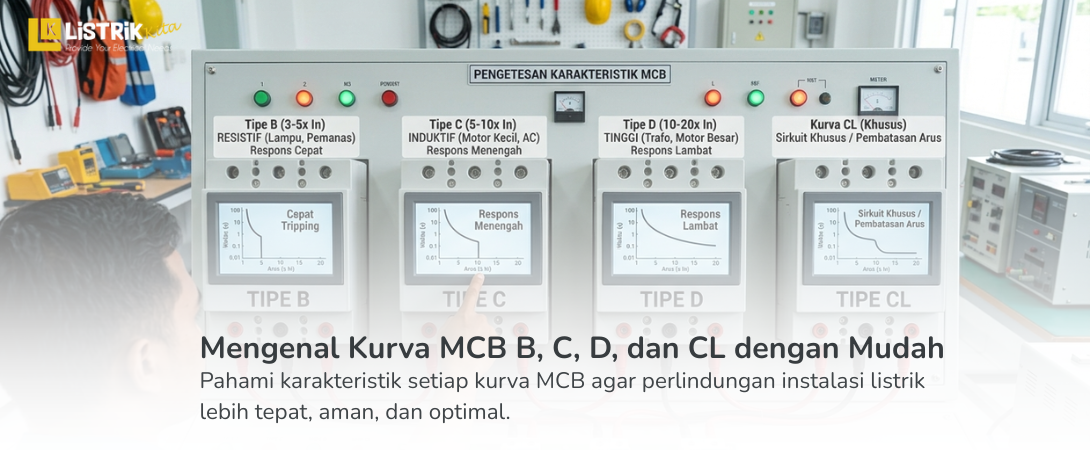
A trip curve describes how an MCB responds when the electrical current exceeds its rated value. It determines how fast the breaker disconnects the circuit under different fault conditions.
In general, an MCB provides two types of protection. The first protects against overloads by responding after a short delay. The second protects against short circuits by disconnecting the circuit almost instantly when a very high fault current occurs.
Since different electrical loads produce different starting currents, manufacturers offer several trip curve options.
Why Choosing the Right MCB Curve Matters
Selecting the correct trip curve helps improve both electrical safety and system reliability.
If the curve is too sensitive, the MCB may trip every time certain equipment starts, even though there is no actual fault. On the other hand, a curve that is not sensitive enough may delay protection and increase the risk of equipment damage.
Types of MCB Trip Curves
B Curve
A B Curve MCB trips instantly when the current reaches approximately 3 to 5 times its rated current. It is designed for loads with very low starting current.
This type is commonly used in residential electrical systems, lighting circuits, wall outlets, and household electronic devices.
Its high sensitivity provides fast protection for standard electrical installations.
C Curve
The C Curve is one of the most commonly used MCB types in commercial buildings and light industrial applications. It trips instantly when the current reaches around 5 to 10 times its rated current.
It is suitable for equipment with moderate starting currents, including air conditioners, water pumps, small electric motors, and small compressors.
This curve helps prevent unnecessary tripping during equipment startup.
D Curve
A D Curve MCB is designed for applications with very high inrush current. It trips instantly only when the current reaches approximately 10 to 20 times its rated current.
It is commonly used for industrial machinery, welding equipment, transformers, conveyors, and heavy production equipment that require high startup current.
This characteristic allows equipment to start normally without causing unwanted interruptions.
CL Curve
Some manufacturers also offer MCBs with a CL Curve. Its characteristics generally fall between the B Curve and the C Curve, although the exact specifications depend on the manufacturer's design.
The CL Curve is often used in control panels, industrial automation systems, and specialized electronic equipment that require a balance between sensitivity and startup current tolerance.
Always check the manufacturer's specifications before selecting this type.
Comparing B, C, D, and CL Curves
Quick Comparison
Curve | Instant Trip Range | Typical Applications |
| B | 3 to 5 times rated current | Residential circuits and lighting |
| C | 5 to 10 times rated current | Air conditioners, pumps, small motors |
| D | 10 to 20 times rated current | Industrial machines and transformers |
| CL | Between B and C depending on manufacturer | Control panels and automation systems |
Which MCB Curve Should You Choose?
There is no universal answer because each electrical installation has different requirements.
Choosing the correct trip curve based on the load characteristics helps improve safety, reduce unnecessary tripping, and ensure reliable electrical system performance.
Common Mistakes When Choosing an MCB Curve
Choosing a Curve That Is Too Sensitive
A highly sensitive curve may cause frequent tripping whenever equipment with a startup current is switched on.
Choosing a Curve That Is Too Slow
A less sensitive curve may delay circuit protection and increase the risk of damage to cables and electrical equipment.
Looking Only at the Current Rating
Many people select an MCB based only on its ampere rating while ignoring the trip curve. In reality, both factors are equally important for effective electrical protection.
Choose the Right MCB Curve for Your Electrical Load
Understanding the differences between B, C, D, and CL curves makes it easier to select the right MCB for your electrical installation. A properly selected breaker improves safety, minimizes unnecessary interruptions, and provides reliable protection for your electrical system.
If you are looking for high quality MCBs for residential, commercial, or industrial applications, explore the wide selection available at Listrik Kita. You can find genuine electrical products from trusted brands to help keep your electrical installation safe and reliable.
