


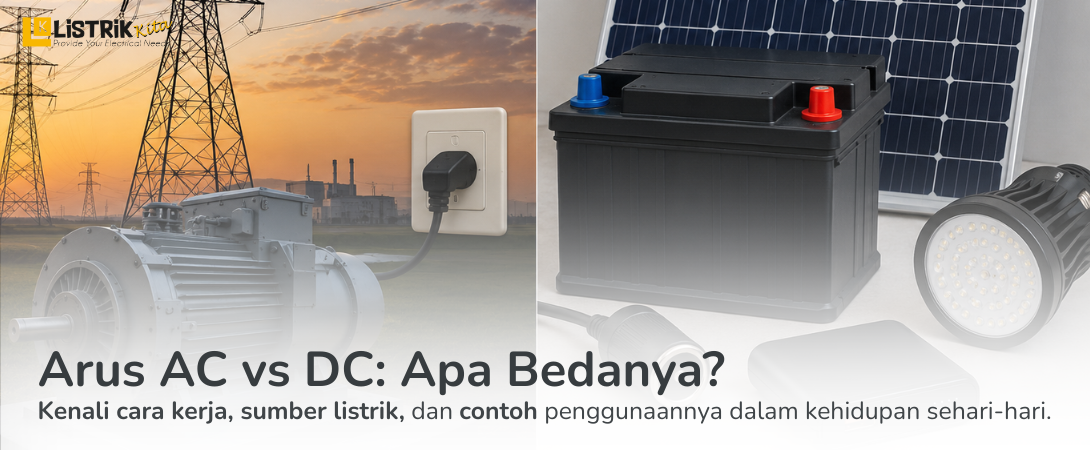
Electricity plays an essential role in modern life. Almost every device we use every day, from lighting systems and household appliances to industrial machinery, depends on electrical energy to operate. However, not all electricity works the same way. In general, electrical power is divided into two main types: alternating current (AC) and direct current (DC).
Understanding the difference between AC and DC is important for homeowners, technicians, engineers, and anyone interested in electrical systems. Although both are used to deliver electrical energy, their characteristics and applications are quite different.
What Is Alternating Current (AC)?
Definition of Alternating Current (AC)
Alternating current, commonly known as AC, is an electric current that periodically changes its direction of flow. Instead of moving continuously in one direction, the electrons reverse direction according to a specific frequency.
In many countries, including Indonesia, the standard power supply operates at 50 Hz, meaning the current changes direction 50 times per second.
Characteristics of AC
The main characteristics of AC include:
- The direction of current changes periodically.
- It functions at a designated frequency, commonly 50 Hz or 60 Hz.
- Transformers make it possible to raise or lower voltage levels with ease.
- It is highly suitable for long-distance power transmission.
Advantages of AC
AC offers several important benefits:
- Efficient for transmitting electricity over long distances.
- Suitable for large-scale electrical distribution networks.
- Lower distribution costs compared to many alternatives.
- Widely used in residential, commercial, and industrial facilities.
Disadvantages of AC
Despite its advantages, AC also has some limitations:
- Many electronic devices cannot use AC directly.
- AC often needs to be converted into DC through adapters or power supplies.
- Proper protection systems are required to ensure safety.
Common Applications of AC
AC is commonly used in:
- Residential electrical systems
- Office buildings
- Shopping centers
- Manufacturing facilities
- Utility power distribution networks
What Is Direct Current (DC)?
Definition of Direct Current (DC)
Direct current, or DC, is an electric current that flows continuously in a single direction. Unlike AC, the polarity remains constant, providing a stable voltage output for many electronic devices.
Characteristics of DC
Key characteristics of DC include:
- Current flows in one direction only.
- It has no frequency, or 0 Hz.
- Voltage output is generally stable.
- Commonly used in modern electronic equipment.
Advantages of DC
The advantages of DC include:
- Ideal for sensitive electronic circuits.
- Provides stable power delivery.
- Suitable for energy storage systems such as batteries.
- Supports renewable energy and electric vehicle technologies.
Disadvantages of DC
Some limitations of DC are:
- Long-distance transmission is generally more complex.
- Voltage conversion requires specialized equipment.
- Distribution infrastructure is less common than AC systems.
Common Applications of DC
DC is widely used in:
- Batteries
- Smartphones
- Laptops
- Solar panels
- UPS systems
- Electric vehicles
Differences Between AC and DC
The table below summarizes the main differences between AC and DC.
Aspect | AC | DC |
| Current Direction | Changes direction periodically | Flows in one direction |
| Source | Generators and utility grids | Batteries, solar panels, power supplies |
| Frequency | 50 Hz or 60 Hz | 0 Hz |
| Transmission Efficiency | Excellent for long distances | Commonly used in electronic systems |
| Safety | Depends on voltage and protection systems | Depends on voltage, current, and exposure duration |
| Main Use | Power distribution | Electronics and energy storage |
| Application Examples | Wall outlets, electric motors, industrial machines | Smartphones, laptops, solar systems, EVs |
Which Is Better, AC or DC?
Neither AC nor DC is universally better because each serves a different purpose. AC is the preferred choice for large-scale power distribution due to its efficiency in long-distance transmission. DC, on the other hand, is ideal for electronic devices, battery systems, solar energy installations, and electric vehicles that require stable power.
In conclusion, both AC and DC are essential parts of modern electrical systems. Understanding their differences can help you select the right equipment, installation methods, and electrical components for your needs. If you are looking for high-quality electrical products such as circuit breakers, contactors, relays, timers, push buttons, cables, and panel accessories, visit Listrik Kita for a complete range of reliable electrical solutions.
