


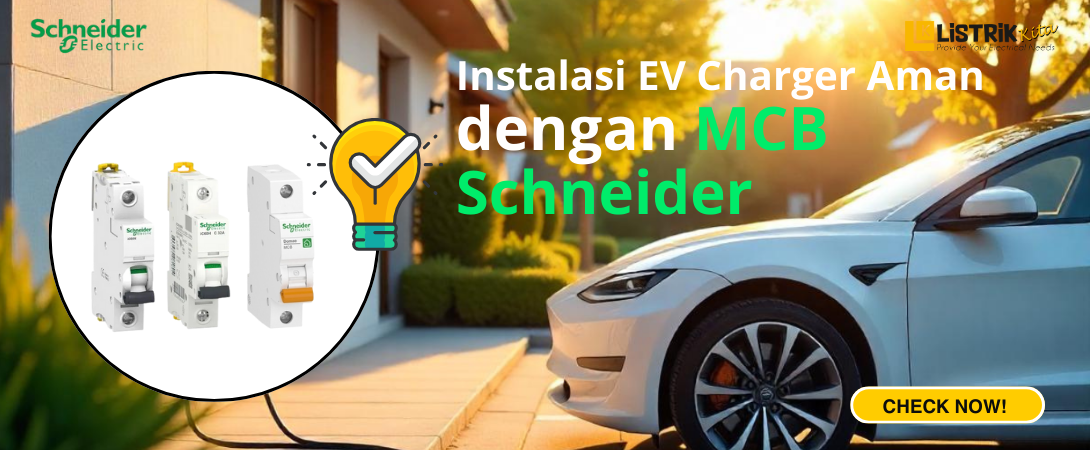
As electric vehicles (EVs) gain popularity in Indonesia, installing EV chargers at homes and public locations is becoming increasingly essential. However, one critical component that often gets overlooked is the Miniature Circuit Breaker (MCB). In fact, choosing the right MCB is crucial to ensuring the safety and reliability of your EV charging system.
In this article, we’ll explore why MCBs matter, what types are best suited for EV charging, and the top product recommendations from Schneider Electric.
Why Choosing the Right MCB Matters for EV Charging
An MCB is an electrical safety device designed to automatically disconnect the power supply when overcurrent or short circuits occur.
When an EV charger—especially fast chargers—is turned on, it often causes a high inrush current. If your MCB isn’t properly rated to handle this, one of two things could happen:
-
The MCB is too sensitive and trips unnecessarily—even when there’s no real fault.
-
The MCB fails to trip, which could lead to overheating or even fire hazards.
That’s why selecting the right MCB is not just about performance—it’s about protecting your home, your equipment, and your family.
Recommended MCB Types for EV Charging
1. Type C MCB
-
Best for: Medium to high inrush current loads (such as EV chargers)
-
How it works: The device trips when the current reaches between 5 and 10 times its rated value.
-
Example: For a 7 kW charger (32A), use a 32A Type C MCB.
-
Benefits: Less likely to trip due to momentary current spikes. Perfectly suited for home and small-scale commercial applications.
2. Type B MCB
-
Best for: Loads with low inrush currents
-
Downside: More sensitive to surges—may trip frequently if used with high-power EV chargers. Not recommended for most modern chargers.
3. Type D MCB
-
Best for: Industrial use or high-powered EV chargers with very high inrush currents.
-
How it works: Trips when the current hits 10 to 20 times the rated value.
-
Note: Rarely used in homes, but ideal for commercial or fast-charging installations.
4. 4-Pole MCB (3 Phase + Neutral)
-
Recommended for: 3-phase EV charger setups
-
Purpose: Ensures all phases and the neutral line are disconnected in the event of a fault.
-
Advantage: Helps prevent "floating neutral" conditions, which can damage sensitive electronic devices.
How to Determine MCB Rating and Capacity
Follow the table below as a guide:
|
Charger Power |
Voltage |
Estimated Current |
Recommended MCB |
|
2.2 kW |
220V |
~10A |
16A Type C |
|
3.5 kW |
220V |
~16A |
20A Type C |
|
7 kW |
220V |
~32A |
32A Type C |
|
11 kW |
3 Phase |
~16A/phase |
3P/4P 20A C or D |
|
22 kW |
3 Phase |
~32A/phase |
3P/4P 40A C or D |
Pro Tip: Always add a 20–25% margin above the working current to avoid nuisance tripping from temporary surges.
Schneider Electric’s Recommended MCBs for EV Charging
???? Domae Series
-
Curve Type: C only
-
Suitable for: Residential and light commercial use
-
Current Range: 2A to 63A
-
Examples:
-
Domae 1P 10A Type C
-
Domae 3P 32A Type C
-
-
Note: Type D is not typically available in this series.
???? Acti9 Series (iC60N & iC60H)
-
Available in: Both C and D curves
-
iC60N: 6kA breaking capacity
-
iC60H: Up to 15kA, for higher-risk installations
-
Examples:
-
iC60N 1P 32A Type C (A9F44132)
-
iC60H 3P 63A Type D (A9F55363)
-
|
MCB Series |
Type C |
Type D |
|
Domae |
Yes |
No |
|
Acti9 iC60N |
Yes |
Yes |
|
Acti9 iC60H |
Yes |
Yes |
Additional Tips for Installing an EV Charger
-
Check Certifications: Ensure the MCB complies with SNI/IEC standards.
-
Check Compatibility: Match your MCB and consumer unit with the technical specs of your EV charger.
-
Consult a Licensed Electrician: For peace of mind and compliance, always work with certified electrical professionals.
For most home installations, a Type C MCB is the safest and most reliable choice. Ensure the MCB rating matches your charger’s power level, and go with reputable brands like Schneider Electric, especially the Domae and Acti9 series.
For fast charging stations or commercial setups, consider Type D MCBs, especially from the Acti9 iC60H series, to handle the higher electrical demand.
Above all, prioritize safety, reliability, and compliance with national standards in every EV charging installation.
Get Schneider Electrics MCB and Schneider Electric EV Chargers only at Listrik Kita. Power your drive safely.
