


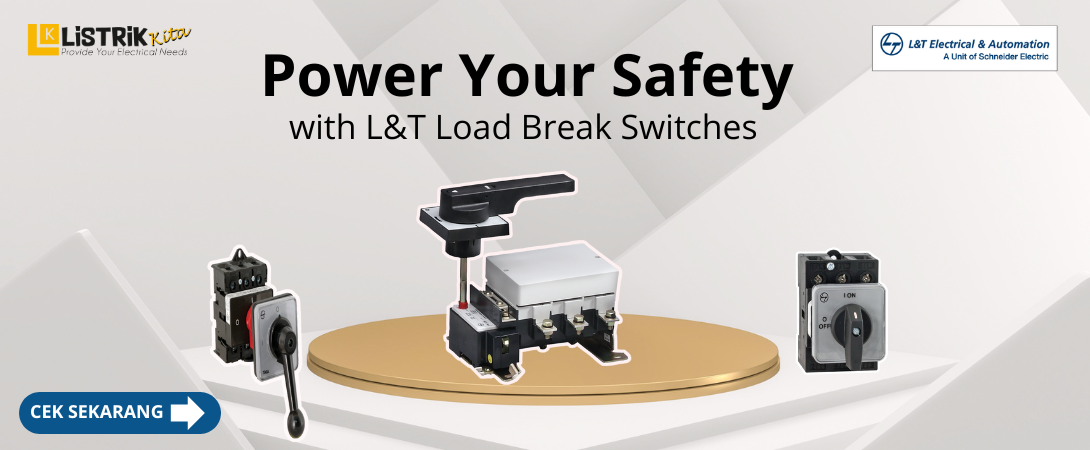
Load Break Switch (LBS) L&T is a reliable electrical device for disconnecting loads. How does it work, and what are its complete specifications?
The electrical distribution system is something dynamic and generally requires careful settings. One of the challenges and can be a safety issue in the electrical distribution system is when a large motor load is added or disconnected from the system.
To prevent this problem from occurring, you must use a special electrical device that can handle this, namely the Load Break Switch. A more complete explanation of LBS, you can see below!
What Is L&T Load Break Switch (LBS)?
Load Break Switch is also commonly called a LBS. This is a tool that will disconnect the electric current from an electrical device or circuit when the current exceeds the nominal value. Generally installed in electrical distribution channels.
Because it is usually in a protective box made of stainless steel, this tool is durable and can be used in various environmental conditions.
LBS is an electrical device that is easy to assemble and use. In addition, it can also be used in public distribution, the industrial sector, distribution panels, motor feeders, and emergency switches.
Basically, the L&T Load Break Switch is designed to connect and also disconnect the load current. LBS can be connected to the fault because of the connection rating but cannot disconnect the fault current.
So, this tool only has the ability to connect or disconnect only in normal conditions, not when a short circuit occurs.
How the L&T Load Break Switch (LBS) Works
So, how does this Load Break Switch work?
When the current exceeds the normal value, this tool will be disconnected by the magnetic field in the main power system, which will then close again when the electricity demand decreases. With this, the peak current will be reduced in the low-impedance circuit.
Load Break Switches can generally be controlled manually or electronically. The working principle is that this tool diverts the current by moving its contacts mechanically at the appropriate speed to create or disconnect the current supply.
"Create" here means closing the current, while "disconnect" means opening the current. During the switching, the switch will experience mechanical, thermal, and dielectric pressure.
L&T Load Break Switch Specifications
The L&T Load Break Switch (LBS) has excellent electrical characteristics with a compact design. Not only that, this electrical device can also contribute to saving space and operational comfort.
L&T's Load Break Switch uses a material containing polyamide glass, which has excellent path resistance as insulation. This is useful for preventing flashover between phases in the most severe conditions.
In addition, the design and special contact configuration make this device have excellent capabilities in withstanding high short circuit currents.
The following are the characteristics of the L&T Load Break Switch:
- Polycarbonate sheath for cable terminal protection
- Double disconnection contract
- Versatile installation options: Front Mounting, DIN 35 Rear Mounting, and Enclosure Mounting
- Quick, simple, and convenient
- Single hole mounting diameter 22.5mm, offered for 16A/20A switches with padlock option
- Finger protection IP 20
- Terminal screws with fixed clamps for easy wiring
- Main/neutral/auxiliary additional contacts can be installed on both sides of the switch on site
- Addition of a fourth pole is possible on site
That's the complete explanation of the L&T Load Break Switch (LBS), from how it works to its specifications.
Want to know other complete specifications of electrical products? Check it out in other Listrik Kita's articles!
Or do you want to find electrical products with the best price and quality? Order the product directly here now!
