


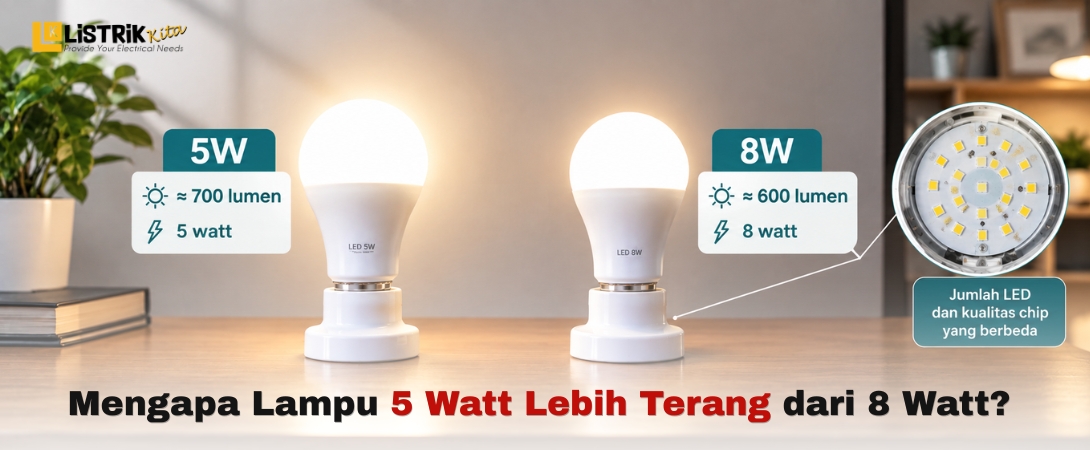
When choosing an LED lamp, many people still believe that a higher wattage always means brighter light. In reality, this is not always the case. A 5-watt lamp can look brighter than an 8-watt lamp depending on its efficiency, LED quality, and how the light is distributed.
Watt measures how much electrical power a lamp uses. Meanwhile, the brightness of a lamp is better represented by its lumen output. Understanding the difference between watts and lumens can help you choose the right lamp for your home, office, store, or other spaces.
Difference Between Watt and Lumen
Watt
Watt (W) is the unit used to measure the electrical power consumed by a lamp. Generally, a higher wattage means the lamp uses more electricity.
However, wattage does not directly tell you how bright the lamp will be. This is especially true for modern LED lighting. Two lamps with different wattages can produce different amounts of light depending on their efficiency and components.
With older technologies such as incandescent bulbs, the relationship between wattage and brightness was easier to understand. With modern LED lamps, efficiency has improved significantly, so comparing lamps based only on wattage is no longer enough.
Lumen
Lumen (lm) measures the total amount of visible light produced by a lamp. If you want to know how much light a lamp produces, lumen is one of the most important specifications to check.
Another useful measurement is lumens per watt (lm/W). This value shows how efficiently a lamp converts electricity into light. The higher the lm/W rating, the more light the lamp can produce from each watt of electricity.
For example, a 5-watt lamp with an efficiency of 140 lm/W can theoretically produce around 700 lumens. An 8-watt lamp with an efficiency of 75 lm/W produces around 600 lumens. In this situation, the 5-watt lamp uses less electricity while producing more light.
Why Can a 5-Watt Lamp Be Brighter?
Several factors can make a lower-wattage lamp produce or appear to produce brighter light.
Higher Lamp Efficiency
The first factor is efficiency. Modern LED technology can produce more lumens while using less electrical power.
For example, a 5-watt lamp may have an efficiency of 120 to 150 lm/W. Meanwhile, an 8-watt lamp may only have an efficiency of 60 to 80 lm/W. In this case, the 5-watt lamp can produce the same amount of light or even more.
The quality of the driver also affects efficiency. A good driver can regulate electrical current more effectively, allowing the lamp to use energy more efficiently.
LED Chip Quality
The LED chip inside the lamp also has a major impact on its performance. High-quality LED chips can produce more light while consuming relatively little power.
A 5-watt lamp equipped with a highly efficient LED chip can produce more light than an 8-watt lamp using a lower-performance chip.
Chip quality can also affect light stability and lamp lifespan. Lower-quality components may lose performance faster, which can cause the light output to decrease over time.
Beam Angle
Another factor to consider is the beam angle. It affects how light is distributed across an area and can change how bright the lamp appears.
A 5-watt lamp with a narrower or more focused beam can direct more light toward a specific area. As a result, the illuminated spot can look brighter.
Meanwhile, an 8-watt lamp with a very wide beam angle spreads its light across a larger area. Although it produces plenty of light, the intensity at a particular point may feel lower.
This means perceived brightness is not determined by wattage alone. Light distribution and the area being illuminated also play important roles.
How to Choose the Right LED Lamp
When buying an LED lamp, do not compare wattage alone. Check the lumen output to understand how much light the lamp produces. You can also consider its lm/W efficiency, color temperature, beam angle, and the lighting requirements of the room.
For a small room, a lamp with an appropriate lumen output may provide enough light without requiring high power consumption. For work areas, warehouses, stores, and spaces that require stronger lighting, lumen output and light distribution should be carefully matched to the application.
In short, a higher-wattage lamp is not necessarily brighter. More efficient LED technology can produce more light while using less electricity. That is why lumen output and efficiency are often more useful than wattage alone when choosing an LED lamp.
Looking for LED lighting for your home, office, store, or electrical installation needs? Explore a variety of LED lamps at Listrik Kita and find options that match your lighting requirements.
