


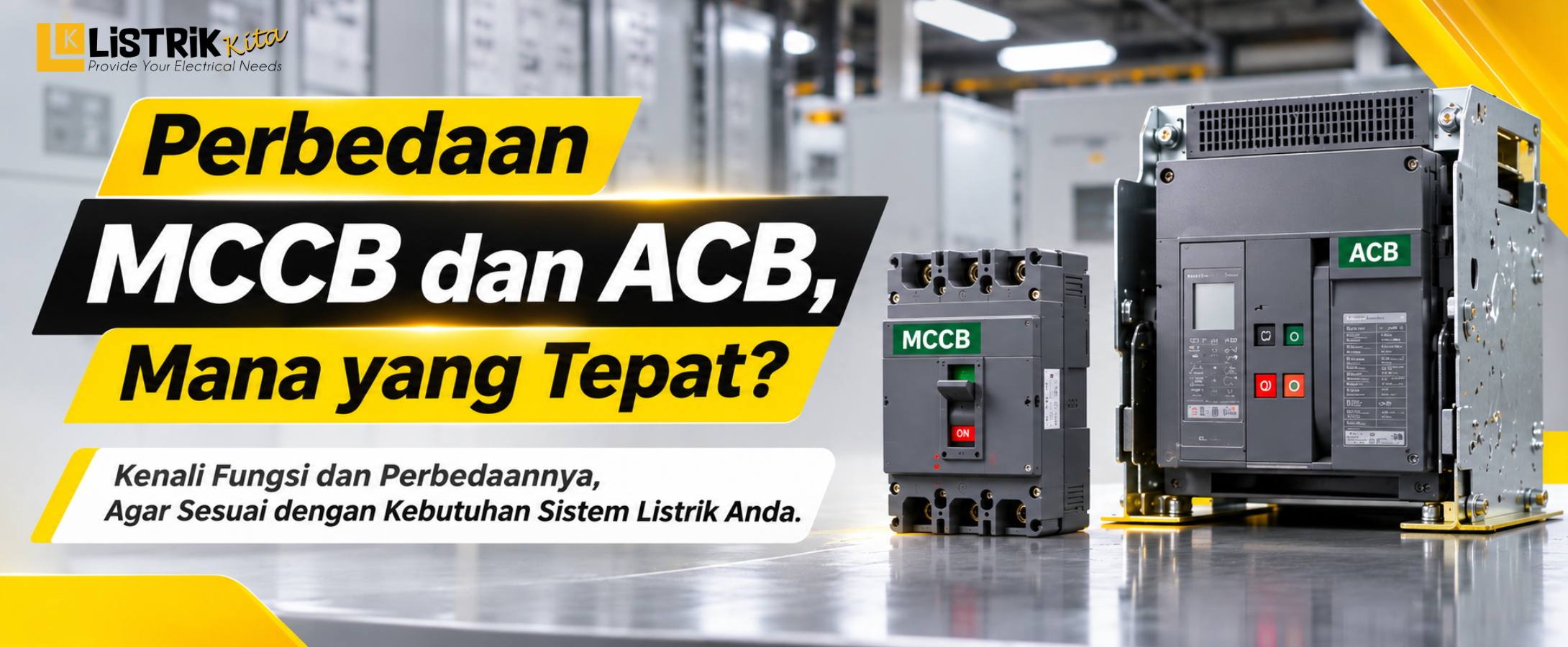
In an electrical system, choosing the right circuit breaker should be based on the capacity and requirements of the installation. Listrik Kita is an official Schneider Electric distributor that provides original and warranty-backed products, including various protection devices for residential, commercial, and industrial applications. Two circuit breakers commonly used in electrical distribution systems are MCCB and ACB. Although both provide electrical protection, they have different characteristics and applications.
Understanding the difference between MCCB and ACB is important before selecting the right device. The main differences can be seen in their names, current ratings, arc extinguishing methods, selectivity, protection roles, physical size, and installation position.
1. Difference in Meaning: MCCB vs ACB
What Is MCCB?
MCCB stands for Molded Case Circuit Breaker. As the name suggests, it uses a molded case to protect its internal components. MCCBs are commonly used in distribution panels and feeders because they are available in various current ratings.
What Is ACB?
ACB stands for Air Circuit Breaker. This type of circuit breaker uses air as the medium to help extinguish the arc when the current is interrupted. ACBs are generally used in larger electrical distribution systems and are often installed as the main circuit breaker.
2. Difference in Current Rating Capacity
MCCB Current Capacity
MCCBs are generally used for low to medium current protection, depending on the product series and specifications. They can protect feeders, machines, distribution panels, and specific groups of loads.
ACB Current Capacity
ACBs are designed to handle higher current capacities than many MCCB applications. This is why ACBs are commonly found at the incoming side of a panel or in main distribution panels where large loads need to be protected.
Current rating should not be selected based only on the load current. The electrical system, cable capacity, load characteristics, and protection requirements should also be considered.
3. Difference in Arc Extinguishing Method
How Does an MCCB Extinguish an Arc?
When a circuit breaker interrupts current, an electrical arc can form between the contacts. In an MCCB, the internal construction is designed to control and extinguish this arc safely within the device.
ACB Uses Air
As indicated by its name, an ACB uses air as the arc extinguishing medium. When the contacts open to interrupt the current, the arc extinguishing mechanism helps stop the electrical flow and keeps the interruption process controlled.
This difference is one of the important characteristics that distinguishes MCCB and ACB construction.
4. Difference in Selectivity
Selectivity in MCCB Applications
MCCBs can be used to protect feeders or outgoing circuits. With proper protection coordination, an MCCB can work together with other protection devices so that a fault in one section does not immediately shut down the entire system.
Selectivity in ACB Applications
ACBs are commonly installed on the main side of a distribution system. Since they often function as an incoming or main breaker, coordination between the ACB and downstream breakers is important to achieve a more selective protection system.
Why Is Selectivity Important?
Selectivity allows the protection device closest to the fault to operate first. This can help minimize the affected area and allow other safe parts of the electrical system to continue operating.
5. Difference in Protection Role
MCCB for Feeder and Load Protection
MCCBs are widely used to provide protection against conditions such as overload and short circuit. Their applications range from distribution panels to circuits supplying different types of loads.
ACB as Main Protection
ACBs are more commonly used as the main protection device in large-capacity electrical distribution systems. An ACB can be installed at the incoming side of a panel to protect the system before power is distributed to multiple feeders.
6. Difference in Physical Size
MCCB Has a More Compact Design
One advantage of an MCCB is its relatively compact design. This makes it more flexible for installation in panels where space is limited.
ACB Has a Larger Construction
ACBs are generally larger than MCCBs. Their larger construction is related to their current capacity, operating mechanism, construction, and available protection features.
Therefore, ACB installation requires consideration of panel space, operating access, and maintenance requirements.
7. Difference in Installation Position
MCCB on the Outgoing Side
MCCBs are commonly installed on the outgoing or feeder side to protect specific circuits. For example, an MCCB can protect the power supply going to a machine, subpanel, or group of loads.
ACB on the Incoming Side
ACBs are commonly installed on the incoming or main side. They function as the main circuit breaker before electrical power is distributed to several circuits or feeders.
Aspect | MCCB | ACB |
| Full Name | Molded Case Circuit Breaker | Air Circuit Breaker |
| Current Rating Capacity | Generally used for low to medium current applications | Generally used for higher current applications |
| Arc Extinguishing Medium | Uses an internal arc extinguishing mechanism within the molded case | Uses air as the arc extinguishing medium |
| Selectivity | Can be used for protection coordination on feeders and outgoing circuits | Commonly used for protection coordination on incoming or main circuits |
| Protection Role | Protects feeders, machines, panels, and groups of loads | Commonly serves as the main protection device in a distribution system |
| Physical Size | Relatively compact | Generally larger |
| Installation Position | Commonly installed on the outgoing or feeder side | Commonly installed on the incoming or main side |
| Common Applications | Distribution panels, feeders, machines, and various loads | Main distribution panels and high-capacity power distribution systems |
MCCB vs ACB, Which One Should You Choose?
MCCB and ACB have the same basic function as circuit breakers, but their applications can differ depending on the electrical system. MCCBs are more flexible for various feeder and distribution applications while offering a relatively compact design. Meanwhile, ACBs are more commonly used as main breakers in distribution systems with higher current capacities.
When choosing between them, do not look only at the current rating. Consider the breaking capacity, protection coordination, load characteristics, panel size, installation position, and operational requirements.
If you are looking for Schneider Electric MCCBs and Schneider Electric ACBs for your electrical installation, you can purchase them through Listrik Kita. Choose the product based on the required specifications and system requirements to achieve reliable electrical protection.
