


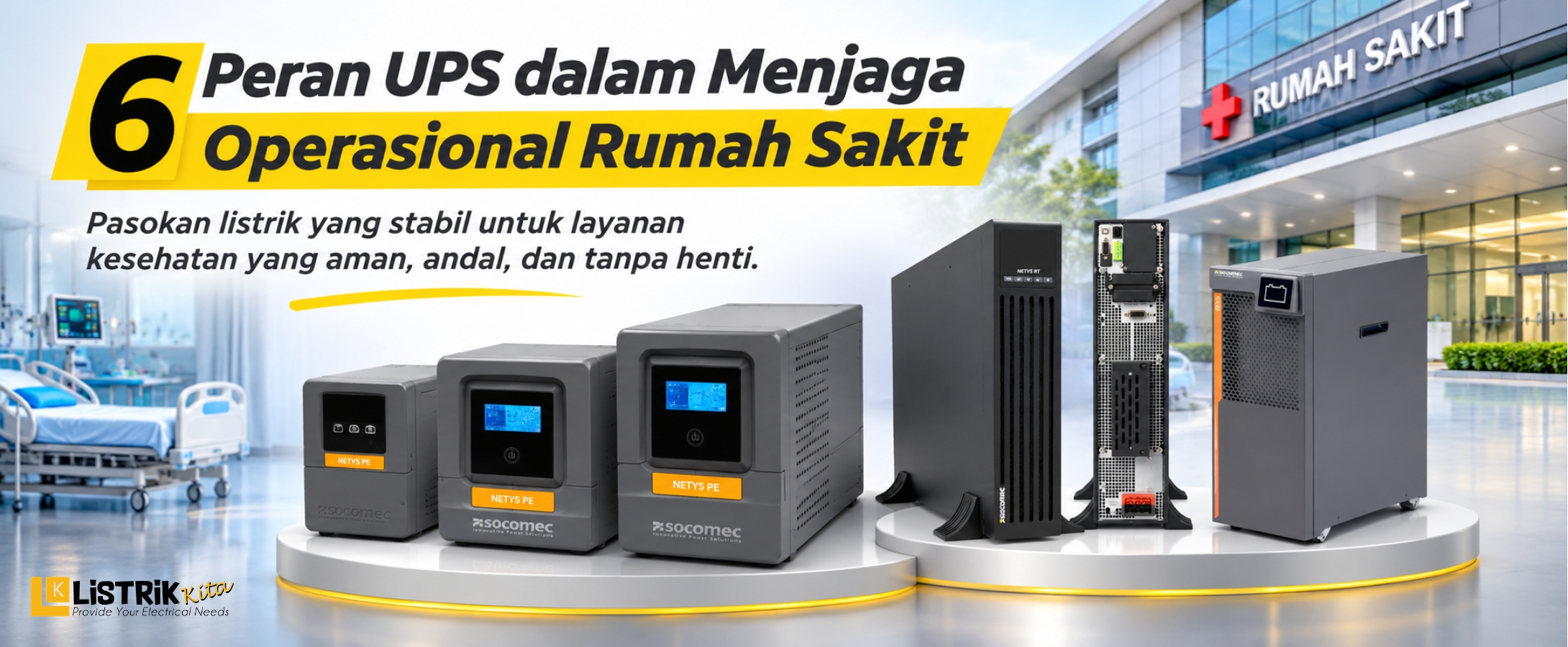
Listrik Kita is an official Socomec distributor providing original and warranty-backed products for various electrical needs. In a hospital environment, reliable power is more than a matter of convenience. It is closely related to patient safety and daily operations. This is why having a UPS in a hospital is important for maintaining power availability when the main electrical supply is interrupted.
Hospitals use many types of equipment that require continuous power. These include medical devices, patient monitoring systems, computers, servers, and electronic medical record systems. Even a short power interruption can affect operations and create problems if critical equipment suddenly shuts down.
The Role of UPS in Hospitals for Reliable Power
Providing UPS Power in Hospitals
A UPS, or Uninterruptible Power Supply, provides backup power when the main electricity supply is interrupted. When a power outage occurs or the electrical supply becomes unstable, the UPS can take over the power supply so connected equipment does not immediately lose power.
This function is especially important in hospitals because some equipment cannot simply wait for a backup source such as a generator to start. A UPS helps keep critical equipment running while the power source is being transferred.
Protecting Patient Safety
Patient safety is one of the main reasons hospitals need a reliable electrical system. Some medical devices must continue operating throughout patient care. A sudden power interruption can affect equipment availability and make it more difficult for medical staff to provide proper treatment.
With a UPS, equipment that requires continuous power can receive backup power when the main supply fails. This helps hospitals maintain service continuity and reduce risks caused by sudden power loss.
Stabilizing Voltage and Frequency
Protecting Equipment from Voltage Problems
Power quality is not only about power outages. Voltage fluctuations, electrical disturbances, and unstable power can also affect electronic and medical equipment.
Depending on its technology and configuration, a UPS can help provide a more stable power supply to connected loads. This can reduce the risk of problems caused by poor power quality.
Supporting Sensitive Medical Equipment
Hospitals use many electronic devices that require good power quality. Monitoring systems, diagnostic equipment, computers, and servers may be affected when the electrical supply is unstable.
For this reason, a UPS is not only a backup power source. It can also become part of the power protection system for sensitive equipment.
Providing Transition Time to the Generator
UPS as a Temporary Power Source
When the main power supply fails, a generator needs some time to start and take over the load. During this period, a UPS acts as a temporary power source to prevent connected equipment from shutting down immediately.
The available backup time depends on the UPS capacity, connected load, system configuration, and battery capacity.
Keeping Equipment Running During the Transfer
The transfer between power sources can be a critical moment for equipment that cannot afford downtime. A UPS helps bridge the gap between the main power supply and the generator so important systems can continue receiving power.
This allows hospital operations to run more smoothly without relying entirely on how quickly the generator can take over.
Protecting Data and Electronic Medical Records
Preventing Data System Interruptions
Hospitals also depend heavily on computers, servers, networks, and information systems. Patient information, administration data, examination results, and electronic medical records all require reliable systems.
A sudden power outage can cause computers or servers to shut down unexpectedly and may interrupt data access or storage processes. A UPS helps keep these systems powered, giving users time to switch to another power source or perform the necessary procedures.
Keeping Hospital Information Systems Running
Hospital information systems need high availability, especially in facilities that operate 24 hours a day. UPS systems can support servers and network equipment that form part of the hospital's IT infrastructure.
With proper power protection, the risk of downtime caused by electrical interruptions can be reduced.
Preventing Damage to Expensive Equipment
Protecting Equipment from Electrical Problems
Medical equipment can represent a significant investment, and some devices are highly sensitive to changes in electrical conditions. Unstable voltage or sudden power loss can affect equipment if proper protection is not available.
A UPS provides an additional layer of protection by supplying backup power and, depending on the UPS type, helping maintain the quality of power delivered to the equipment.
Reducing Downtime and Repair Costs
Equipment failure does not only result in repair or replacement costs. When an important device cannot be used, hospital services can also be affected.
For this reason, a UPS can be part of a strategy to maintain the availability of critical equipment while reducing the risk of unexpected downtime.
A UPS plays an important role in maintaining reliable power in hospitals. It can provide backup power, support the continuity of medical equipment, provide transition time before a generator takes over, protect data systems, and reduce the risk of disruptions to high-value equipment.
The right UPS should be selected based on the required load, power capacity, backup time, equipment type, and electrical system configuration. For original and warranty-backed Socomec UPS, you can purchase through Listrik Kita. Choose the right Socomec UPS for your hospital's electrical needs and support reliable power for critical healthcare operations.
