


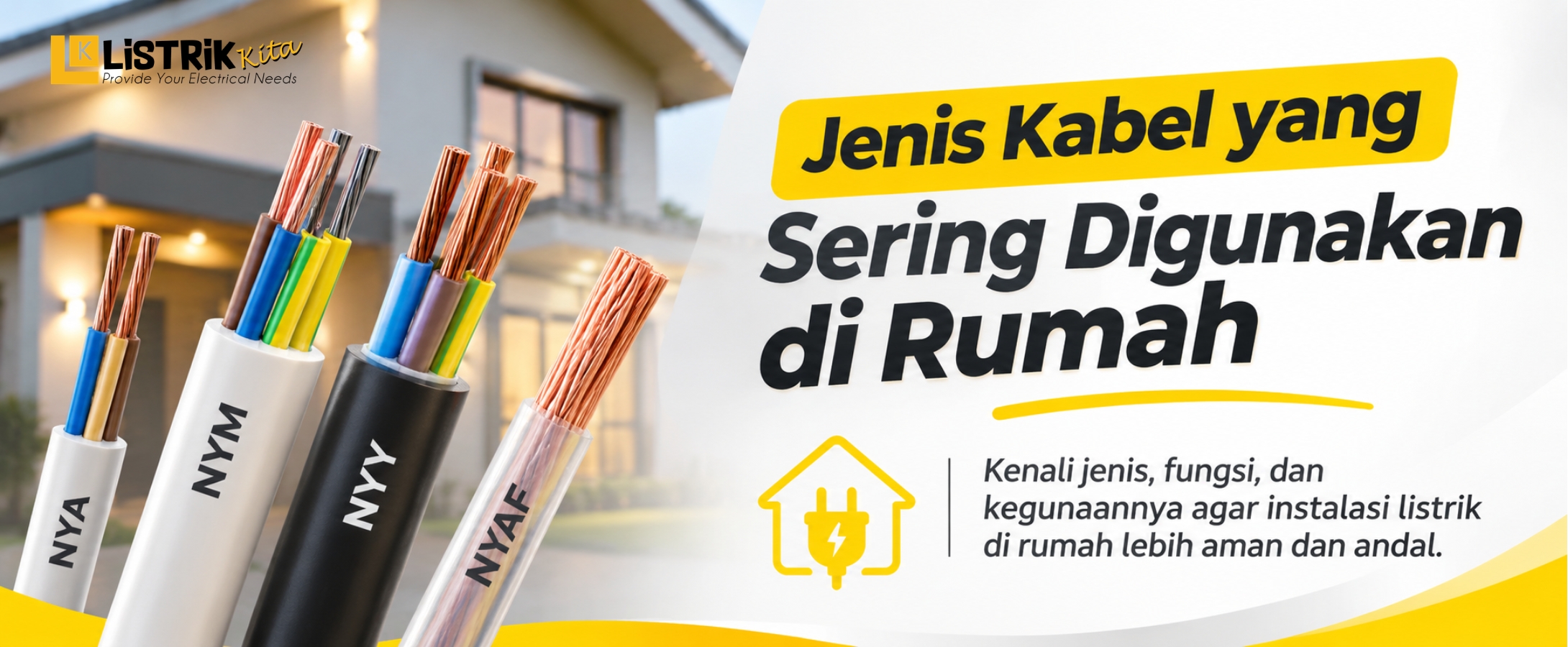
Choosing the right cable is an important part of a home electrical installation. Each cable type has different characteristics and uses, so it should be selected based on the installation requirements. Listrik Kita is an official Supreme partner that provides original and warranty-backed products, making it easier to find cables for various residential electrical needs.
Cables play an important role in an electrical system because they carry electrical current from one point to another. Besides the cable type, the conductor cross-sectional area also needs attention so the cable can handle the required electrical load. So, what types of cables are commonly used at home, and how do you choose the right size?
Common Types of Electrical Cables Used at Home
NYM Cable
NYM is one of the cable types commonly used in residential electrical installations. It consists of several conductors, with each conductor covered by insulation and protected by an outer sheath.
Because it has multiple layers of insulation, NYM is commonly used for electrical installations inside buildings. It can be used for lighting circuits, socket outlets, and other residential electrical applications.
Even with its insulation layers, the cable should still be installed according to the surrounding conditions and installation requirements. Using the right cable can help maintain the safety and reliability of the electrical system.
NYA Cable
Unlike NYM, NYA is a single-core cable with an insulation layer around the conductor. It is commonly installed inside pipes or conduits to provide additional protection.
NYA is widely used in residential installations because it is simple and easy to install. However, since it has a single insulation layer, it should not be left exposed without suitable protection.
Using pipes or conduits can also help protect the cable from mechanical damage and environmental conditions that may affect the insulation.
NYY Cable
NYY cable has an outer sheath designed to provide additional protection to the conductors. This construction makes NYY suitable for installations where the cable requires stronger protection.
NYY can be used for both indoor and outdoor installations, depending on the installation conditions and cable specifications. It can also be used for electrical routes that require better protection against environmental exposure.
The choice of NYY should still consider the installation requirements, including the installation location, electrical load, and installation method.
NYAF and NYMHY Cables
NYAF and NYMHY are known for their flexibility compared with some other electrical installation cables. This flexibility makes them easier to use in applications where the cable needs to be bent or moved.
NYAF generally uses a flexible stranded conductor with a single core, while NYMHY is a flexible multi-core cable. Both can be used for specific applications, such as connections to electrical equipment or parts of an installation that require a more flexible cable.
Even though these cables are flexible, the selection should still consider voltage, current, installation conditions, and the intended application.
Cable Cross-Sectional Sizes Based on Their Use
Besides the cable type, the conductor cross-sectional area is another important factor. Cable size affects its ability to carry electrical current. Higher electrical loads generally require a larger conductor size, while the installation method and applicable requirements also need to be considered.
1.5 mm² Cable for Lighting
A 1.5 mm² cable is commonly used for residential lighting circuits. This size is often applied to lighting because lighting loads are generally lower than those of high-power electrical equipment.
However, cable selection should not be based only on the type of equipment. Cable length, installation method, number of loads, and electrical protection should also be considered.
2.5 mm² Cable for Socket Outlets
For socket outlet circuits, 2.5 mm² is a commonly used cable size in residential installations. Socket outlets may supply different appliances such as televisions, computers, refrigerators, and other household equipment.
Since the load connected to a socket can vary, the cable capacity and circuit protection should be selected according to the actual load. Not every household appliance should automatically use the same cable size.
4 mm² or Larger Cable for Higher Loads
For equipment with higher power requirements, a 4 mm² or larger conductor may be considered based on the electrical installation calculation. Examples may include circuits for pumps, water heaters, certain air conditioners, or other equipment with relatively high electrical loads.
A larger cable does not automatically mean it is always the better choice. The size should be selected based on the load current, cable length, installation method, ambient temperature, and the protection device being used.
How to Choose the Right Electrical Cable for Your Home
Match the Cable Size to the Electrical Load
Before selecting a cable, determine the power or current that will flow through the circuit. The cable should have an appropriate current-carrying capacity for safe operation.
Consider the Cable Type and Installation Location
The installation environment also affects cable selection. Cables installed inside a building may have different requirements from those installed in areas with greater environmental exposure.
Choose Quality Cables That Meet Applicable Standards
Cable quality can affect the safety and reliability of an electrical installation. Make sure the product has clear specifications and is suitable for the electrical system.
Make Sure the MCB Protection Matches the Cable Circuit
Cable selection should also be considered together with protective devices such as MCBs. The protection should match the conductor capacity and circuit load to help the electrical system operate safely.
Cable type and size are important parts of a residential electrical installation. NYM, NYA, NYY, NYAF, and NYMHY cables have different characteristics and applications. Meanwhile, sizes from 1.5 mm² and 2.5 mm² to 4 mm² or larger should be selected based on the electrical load, installation location, installation method, and other technical factors.
If you are looking for electrical cables for residential or other installation needs, Supreme cables from Listrik Kita can be a suitable choice. Listrik Kita provides original Supreme products with warranty support to help meet your electrical needs. Choose the cable type and size according to your installation requirements so your electrical system can operate safely and reliably.
