


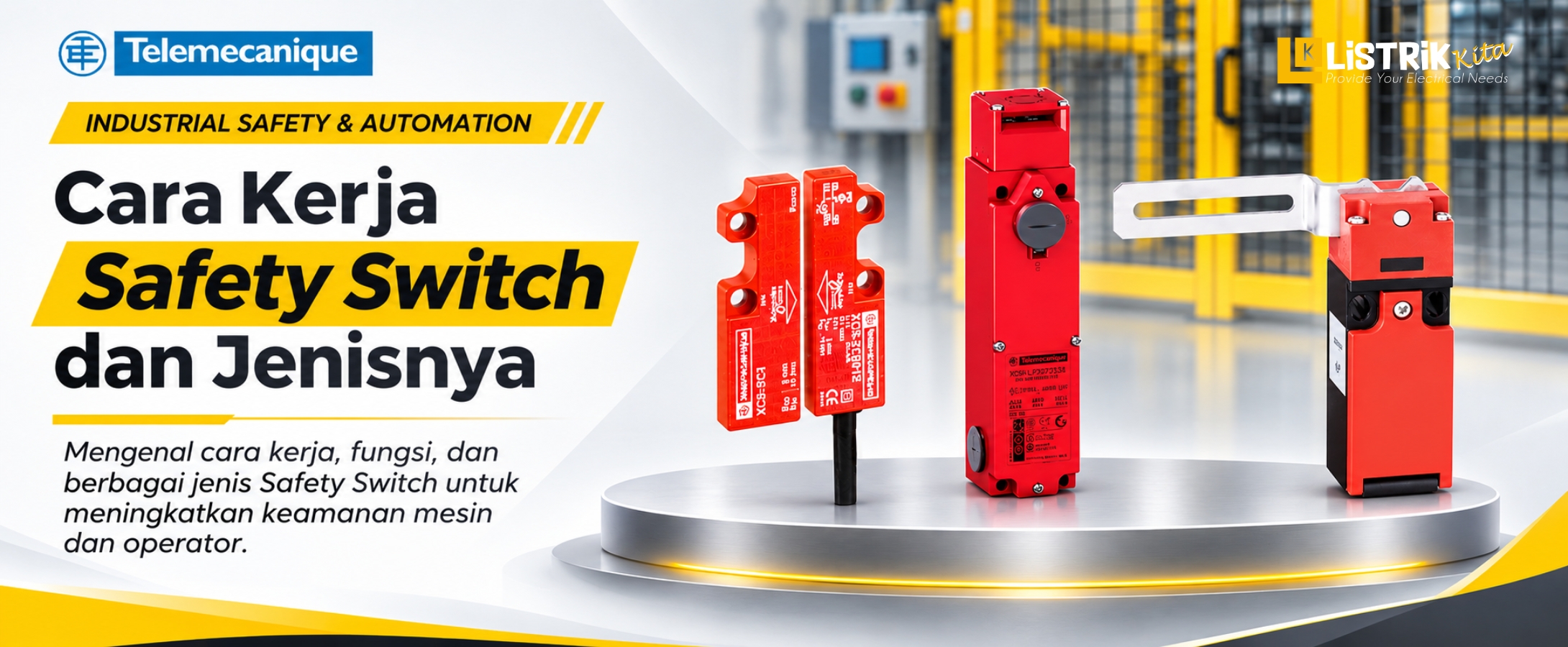
In electrical systems and industrial automation, safety is an important part of daily operations. One of the devices used to improve machine safety is a safety switch. Listrik Kita is an official distributor of Telemecanique Sensors, providing original and guaranteed products, including various sensors and switches for industrial applications. So, how does a safety switch actually work, and what types are commonly used?
What Is a Safety Switch and What Does It Do?
A safety switch is a device designed to detect certain conditions and provide a response when a situation may put the operator, machine, or process at risk. It can be connected to a control circuit so the machine can stop or be prevented from operating when an unsafe condition is detected.
The Function of a Safety Switch in a Safety System
A safety switch helps monitor the condition of a machine or work area. For example, a safety interlock switch can be installed on a machine guard or door to make sure the machine only operates when the guard is in the correct position.
If the door is opened while the machine is running, the switch can send a signal to the control system to stop the operation. This helps reduce the risk of an operator coming into contact with moving machine parts.
Why Are Safety Switches Important for Machines?
Industrial machines can have moving parts that operate at high speed or generate significant energy. Without proper safety measures, these conditions can increase the risk of accidents.
A safety switch is one part of a machine safety system that helps keep the equipment in a safer condition when a specific change or problem occurs.
Basic Working Principle of a Safety Switch
The basic operation of a safety switch is related to changes in electrical contact conditions. Two common types of contacts are Normally Closed or NC and Normally Open or NO.
Understanding Normally Closed (NC) Contacts
A Normally Closed or NC contact is connected when the switch is in its normal, inactive state. In safety circuits, NC contacts are often used to monitor normal conditions and detect when a fault or unsafe condition occurs.
When the switch is activated because an unsafe condition is detected, the contact can open and interrupt the control circuit. The system can then send a command to stop the machine or move it into a safer state.
Understanding Normally Open (NO) Contacts
Unlike an NC contact, a Normally Open or NO contact remains open when the switch is in its normal state. The contact closes when the switch is activated.
NO contacts can be used to send a specific signal to a control system. In safety applications, their use depends on the design of the circuit and the function required from the switch.
Safe Condition
Under normal and safe conditions, the safety switch remains in a position that allows the system to operate as designed. For example, with a safety interlock switch, the machine guard is closed and the switch detects that the condition is safe.
The signal is then passed to the control circuit, allowing the machine to continue operating.
Unsafe Condition
When a safety switch detects an unsafe condition, the contact status can change and send a signal to the control system. The system may stop the machine, prevent it from starting, or change its operation according to the safety design.
For this reason, the type and installation of a safety switch should match the machine and its application.
How Safety Switches Work by Type
Safety switches are available in different types for different safety requirements. Here are some common types used in industrial and equipment applications.
Safety Interlock Switch
A safety interlock switch is commonly installed on machine doors, covers, or guards. Its purpose is to make sure the machine can only operate when the protective part is in a safe position.
When the door or guard is opened, the safety interlock switch can change its contact state and send a signal to the control circuit. The machine can then stop or remain disabled until the guard is returned to the correct position.
Emergency Stop Switch
An emergency stop switch is used when an operator needs to stop a machine quickly during an emergency. It is usually installed in an easy-to-reach location so it can be activated when a dangerous situation occurs.
When the emergency stop is pressed, the switch contacts change state and the control system receives a signal to stop the machine. Once the emergency has been handled, the system normally needs to be reset according to the operating procedure before the machine can run again.
Side Stand Switch
A side stand switch is used to detect the position of a vehicle's side stand. It helps prevent the vehicle from moving when the side stand is still in an unsafe position.
When the side stand is lowered, the switch changes its condition and the system can respond by preventing vehicle operation. When the side stand is raised, the switch returns to the condition required for normal operation.
Pull-Cord Switch
A pull-cord switch is commonly used on conveyor systems, especially when emergency stopping is needed from different points along the conveyor.
The switch is installed with a cord that can be pulled by an operator. When an emergency occurs, the operator can pull the cord, causing the switch to change state and send a stop signal to the control system. This allows the conveyor to be stopped without requiring the operator to reach the main control panel.
Differences in Safety Switch Applications
Each safety switch is designed for a different purpose. A safety interlock switch is suitable for monitoring machine doors or guards, while an emergency stop switch is designed for emergency stopping.
A side stand switch is used to detect the position of a vehicle side stand, while a pull-cord switch is commonly used on long conveyor systems.
When selecting a safety switch, it is important to consider the machine type, operating environment, safety mechanism, and control system requirements. Choosing the right device can help the safety system work effectively and reduce risks during operation.
Safety switches basically work by detecting a specific condition through changes in electrical contacts and then providing a response to the control system. NC and NO contacts have different characteristics, so they need to be selected according to the circuit and safety function.
Safety switch types such as safety interlock switches, emergency stop switches, side stand switches, and pull-cord switches also have different applications. Choosing the right product is an important part of building a reliable safety system for machines and equipment.
For Telemecanique Sensors safety switches, you can purchase them through Listrik Kita. Get original and guaranteed products to support your industrial automation and machine safety needs.
