


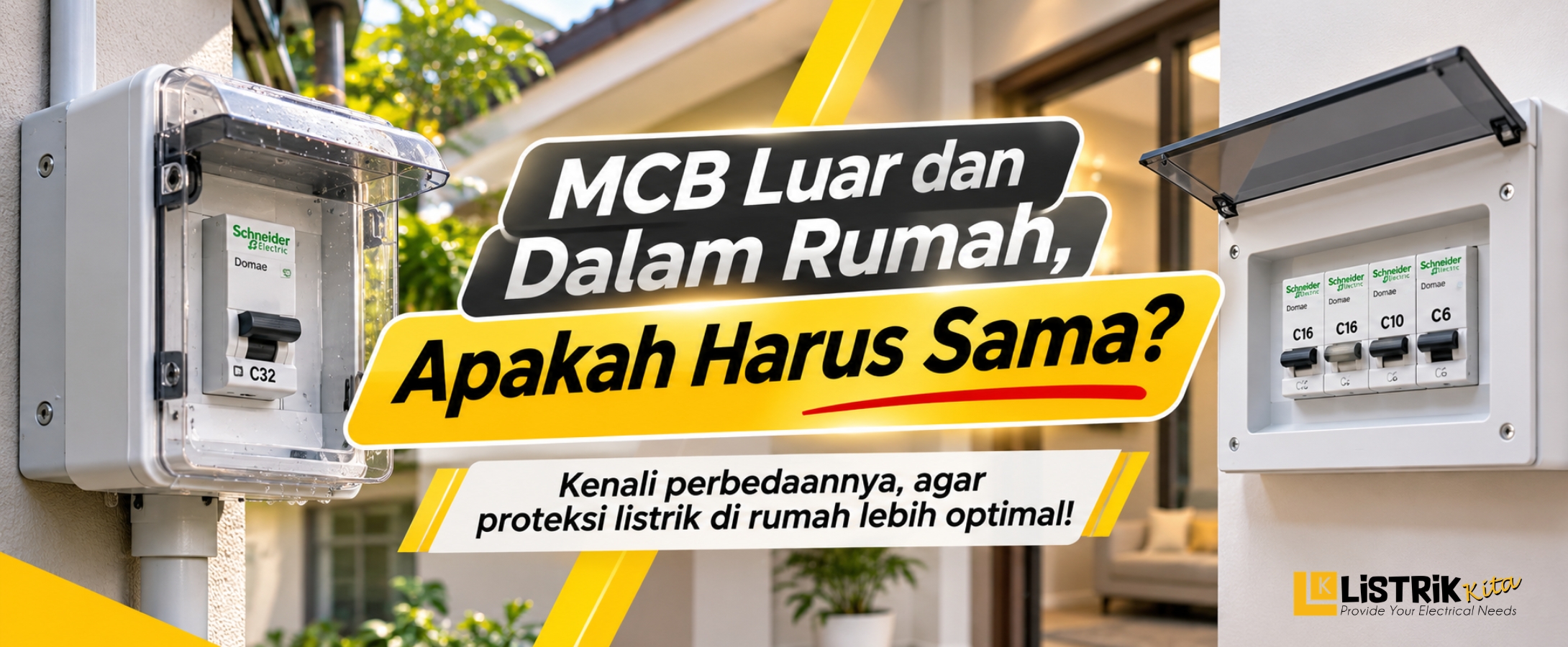
When it comes to home electrical installations, an MCB is one of the important components that should not be overlooked. An MCB, or Miniature Circuit Breaker, helps protect an electrical installation from conditions such as overloads and short circuits. But did you know that the MCB located outside the house at the kWh meter and the MCB installed inside the home's electrical panel have different functions? Listrik Kita is an official Schneider Electric distributor that provides original and guaranteed products for various electrical needs.
This often raises a question: should the ampere rating of the outdoor MCB and indoor MCB be the same? The answer is not necessarily. Both MCBs have different roles in a home's electrical protection system. Understanding the difference is important to make sure the electrical distribution in your home works properly and safely.
Differences Between Outdoor and Indoor MCBs
Outdoor MCB at the kWh Meter
The MCB located at the kWh meter works as the main power limiter based on the electricity capacity installed for the customer. It is part of the electrical system before the power is distributed to different circuits inside the house.
Unlike the MCB installed in the home's electrical panel, the MCB at the kWh meter uses a type determined according to PLN requirements. Since it is related to the customer's electricity capacity, it should not be replaced or modified without permission from PLN.
For example, a house with a certain electrical capacity will have a corresponding current limit. When electricity usage exceeds this limit, the main MCB may trip and disconnect the power supply.
Indoor MCB in the Electrical Panel
The MCB installed inside the house has a more specific role. It works as a protection device and also divides the electrical supply into several circuits or groups.
A home electrical panel can have several MCBs for different circuits. For example, one MCB can protect the lighting circuit, while others can be used for sockets, the kitchen, air conditioners, water pumps, or other areas.
Indoor MCBs can use standard products available on the market, as long as they are selected according to the installation requirements. The MCB rating should also match the cable capacity and the load of each circuit.
Should the Ampere Ratings Be the Same?
Indoor MCBs Should Generally Be Smaller
As a general principle, the ampere rating of an indoor circuit MCB should be smaller than the main MCB at the kWh meter. However, the rating should not be selected based only on the ampere value. The cable capacity and electrical load of each circuit also need to be considered.
For example, if a problem occurs in the kitchen circuit, the MCB protecting that circuit should ideally trip first. This allows the affected circuit to be disconnected while other circuits in the house can continue operating.
This arrangement is related to the concept of protection selectivity. The goal is for the protective device closest to the fault to operate first.
Why Is MCB Selectivity Important?
Imagine there is a short circuit at a socket in the kitchen. If the kitchen circuit has its own properly rated MCB, that MCB can trip and disconnect the kitchen circuit.
This is more practical than having the entire house lose power. You also do not need to go outside to reset the main MCB at the kWh meter just because a problem occurred on one circuit.
Example of MCB Distribution in a House
Main MCB and Circuit MCBs
In a home electrical installation, the main MCB at the kWh meter acts as the overall power limiter. The electrical supply can then be divided into several circuits through the electrical panel inside the house.
For example, one circuit can be used for lighting, another for power sockets, and another for higher-power equipment such as air conditioners or water pumps.
This type of circuit distribution makes the electrical system easier to manage. When one circuit experiences a fault, the tripped MCB can help identify which circuit has the problem.
What Happens If There Is a Short Circuit in the Kitchen?
Suppose a short circuit occurs in a kitchen appliance or socket. If the kitchen circuit has its own MCB, that MCB can trip and stop the electrical supply to that circuit.
With proper circuit distribution, other rooms do not necessarily have to lose power. Once the source of the problem has been identified and the installation is considered safe, the circuit MCB can be turned back on according to the proper procedure.
What Happens If the Indoor MCB Is Too Large?
The MCB May Not Provide Proper Protection
Using an MCB with a rating that is too large for a particular circuit can reduce the level of protection provided to the cable. An MCB should be selected based on the cable capacity and the characteristics of the electrical load.
For this reason, do not simply replace an MCB with a larger rating because it trips frequently. An MCB that keeps tripping can indicate an overload, short circuit, or another issue in the electrical installation that needs to be checked.
How to Choose the Right MCB Rating
Match the MCB to the Cable and Load
Choosing an MCB requires consideration of several factors, including cable size, electrical capacity, type of load, and circuit distribution. Equipment such as air conditioners, water pumps, water heaters, and other household appliances may also have different power requirements.
The basic principle is not simply to make the indoor MCB smaller than the outdoor MCB. The MCB rating must match the cable capacity and the requirements of each circuit so that the protection system can work properly.
Do Not Simply Use the Same Ampere Rating
The outdoor and indoor MCBs do not necessarily need to have the same ampere rating. The MCB at the kWh meter works as the main power limiter, while the MCBs inside the electrical panel protect and divide the electrical installation into several circuits.
Understanding the function of each MCB can help you create a more organized electrical installation and make it easier to identify and handle problems when they occur.
Outdoor and indoor MCBs do not necessarily need to have the same ampere rating. The MCB at the kWh meter works as the main power limiter, while the MCBs inside the electrical panel are used to protect and divide the electrical circuits.
In general, indoor circuit MCBs should have a smaller rating so that a fault on one circuit can be disconnected first without immediately shutting down the entire house. However, the MCB rating must still be selected based on the cable capacity, electrical load, and overall installation design.
If you are looking for Schneider Electric MCBs for your home electrical installation, you can purchase original and guaranteed products from Listrik Kita. Choose the Schneider Electric MCB that matches your installation needs and get reliable electrical products for your project.
