


Measuring electrical current is an important part of electrical work. It helps technicians check whether an installation or electrical equipment is operating properly. One of the tools commonly used for this purpose is a clamp meter, also known as a clamp ammeter. Listrik Kita is a Fluke partner that provides original and guaranteed products, including measuring instruments for electrical applications.
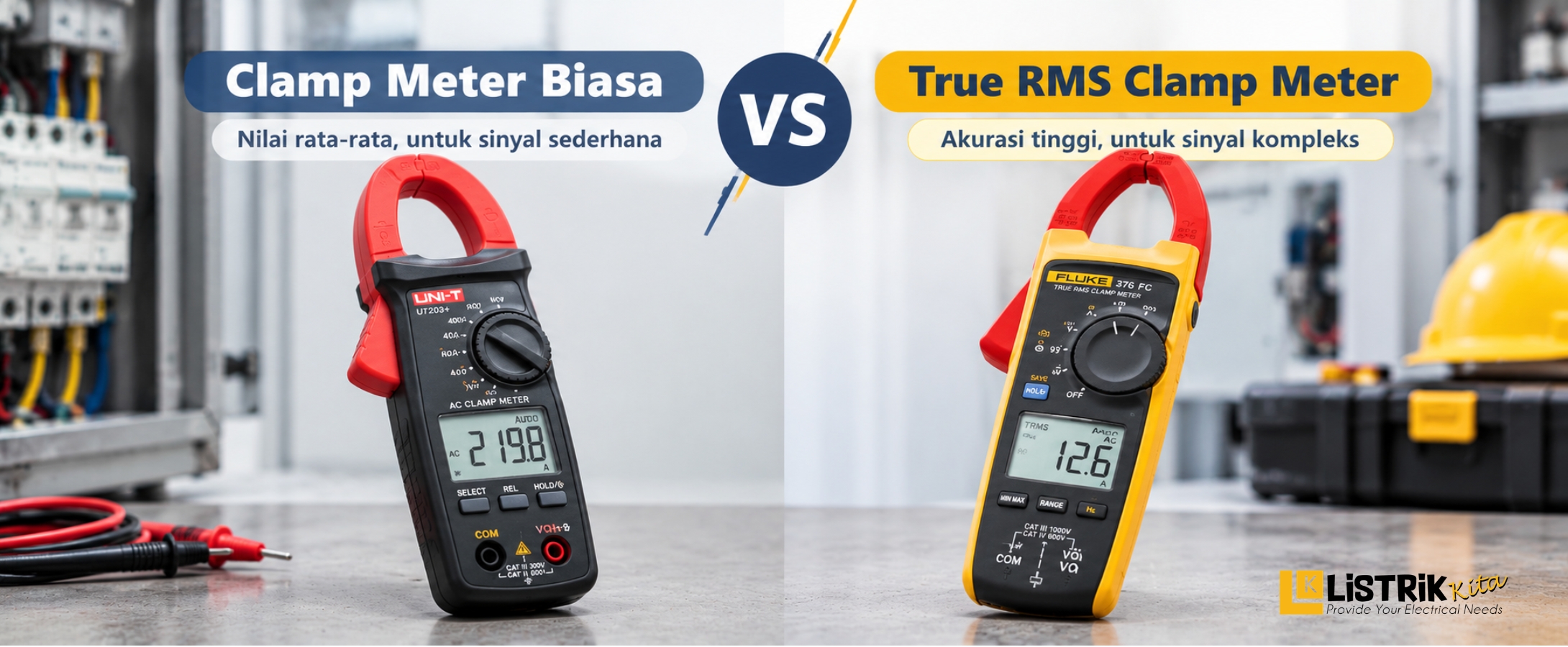
Although both types of clamp meters can measure current without disconnecting the cable, they do not always use the same measurement method. In general, there are standard clamp meters that use average sensing and True RMS clamp meters that use the Root Mean Square method. So, what is the difference between them, and when should each type be used?
What Is a Clamp Meter and What Is It Used For?
A clamp meter is an electrical measuring instrument that allows users to measure current by placing the jaws around a conductor. This makes the measurement process easier because the cable does not need to be disconnected or cut.
Depending on the model, a clamp meter can also measure voltage, resistance, continuity, frequency, and temperature. This makes it useful for electrical installation, maintenance, troubleshooting, and panel inspection.
Why Does the Measurement Method Matter?
An ideal AC current has a sinusoidal waveform. However, many modern electrical devices can produce waveforms that are no longer purely sinusoidal. This can affect measurement results, especially when using a meter based on average sensing.
This is where the difference between a standard clamp meter and a True RMS clamp meter becomes important.
What Is a Standard or Average Sensing Clamp Meter?
An average sensing clamp meter measures an AC signal based on the average value of the waveform and then converts it to estimate the RMS value. This method works well when the measured waveform is relatively sinusoidal.
Advantages and Limitations of Average Sensing
One advantage of an average sensing clamp meter is its simple operation and generally lower cost. For basic AC current measurements on loads with a normal waveform, it can provide suitable results.
However, the reading may become less accurate when the meter is used with non-linear loads. Equipment such as inverters, variable speed drives, UPS systems, and switching power supplies can produce distorted waveforms.
When Should You Use Average Sensing?
A standard clamp meter can be a practical choice for simple electrical work involving relatively linear loads and AC waveforms that are close to sinusoidal. It can still be useful for basic checks on conventional electrical installations.
What Is a True RMS Clamp Meter?
True RMS stands for Root Mean Square. A True RMS clamp meter is designed to calculate the effective value of an electrical signal based on its waveform, including signals that are distorted.
Why Is True RMS More Accurate?
With non-linear loads, the current waveform can change because of the way the equipment consumes electrical power. When the waveform is no longer sinusoidal, an average sensing meter may produce a reading that differs from the actual RMS value.
A True RMS clamp meter can provide a more representative measurement of the effective current under these conditions. This makes True RMS more suitable for electrical environments that use modern electronic equipment.
Examples of True RMS Applications
True RMS clamp meters are commonly used to check equipment such as inverters, variable speed drives, UPS systems, computers, switching power supplies, and other electronic devices. They are also useful when technicians need to troubleshoot systems with non-linear loads.
Difference Between Standard and True RMS Clamp Meters
The main difference between the two is how they process the electrical signal to produce the measurement result.
Difference in Waveform Measurement
Average sensing clamp meters work best with sinusoidal AC waveforms. True RMS meters are better suited to signals with distorted waveforms.
Difference in Measurement Accuracy
With linear loads and sinusoidal waveforms, the difference between the two methods may not be significant. However, when measuring non-linear loads, an average sensing meter may show a result that differs more from the actual value.
Difference in Applications
Average sensing is suitable for basic measurements and systems with relatively simple loads. True RMS is more suitable for technicians working with modern electrical systems that include electronic devices and non-linear loads.
Feature / Characteristic | Standard Clamp Meter | True RMS Clamp Meter |
| Measurement Method | Average measurement multiplied by a sine-wave factor of 1.1 | Actual effective value (Root Mean Square) |
| Waveform | Most accurate with pure sinusoidal waveforms | Accurate with sine, square, triangular, and distorted waveforms |
| Suitable Loads | Linear loads such as incandescent lamps, irons, simple AC motors, and water pumps | Non-linear loads such as inverters, solar PV systems, VFDs, inverter generators, and switching power supplies |
| Price | Generally more affordable | Generally more expensive |
| How to Identify It | Usually does not have a specific marking on the body | Usually marked “True RMS”, “TRMS”, or “VRMS” |
Why Is True RMS Important for Modern Electrical Equipment?
Modern electrical systems increasingly use electronic equipment. Inverters, VFDs, UPS systems, and switching power supplies are examples of equipment that can produce non-ideal current waveforms.
Measuring Inverters and VFDs
Inverters and VFDs control the electrical power supplied to motors. This process can produce current waveforms that differ from a pure sine wave. In these situations, True RMS can help technicians obtain a more representative measurement.
Measuring UPS Systems and Switching Power Supplies
UPS systems and switching power supplies can also behave as non-linear loads. During maintenance or troubleshooting, a True RMS clamp meter can help provide a more reliable view of the current being measured.
Which Is Better, Standard or True RMS?
There is no single option that is best for every application. The right clamp meter should be selected based on the electrical system and the characteristics of the load being measured.
Choose Average Sensing for Simple Measurements
If you only need to measure AC current in an installation with relatively linear loads, an average sensing clamp meter can be a practical choice.
Choose True RMS for More Complex Systems
If your work involves inverters, VFDs, UPS systems, computers, switching power supplies, or other electronic equipment, a True RMS clamp meter is worth considering because it can provide a more representative reading when the signal is distorted.
The difference between a standard clamp meter and a True RMS clamp meter is not simply about features. They use different approaches to measure AC signals. Average sensing is suitable for sinusoidal waveforms and relatively simple systems, while True RMS is more suitable for systems with non-linear loads and distorted waveforms.
If you need a clamp meter for electrical installation, maintenance, or troubleshooting, choose a tool that matches the characteristics of the system you are testing. Listrik Kita provides a range of original and guaranteed Fluke clamp meters to support your electrical measurement needs. Find and buy the right Fluke clamp meter for your application at Listrik Kita.
