


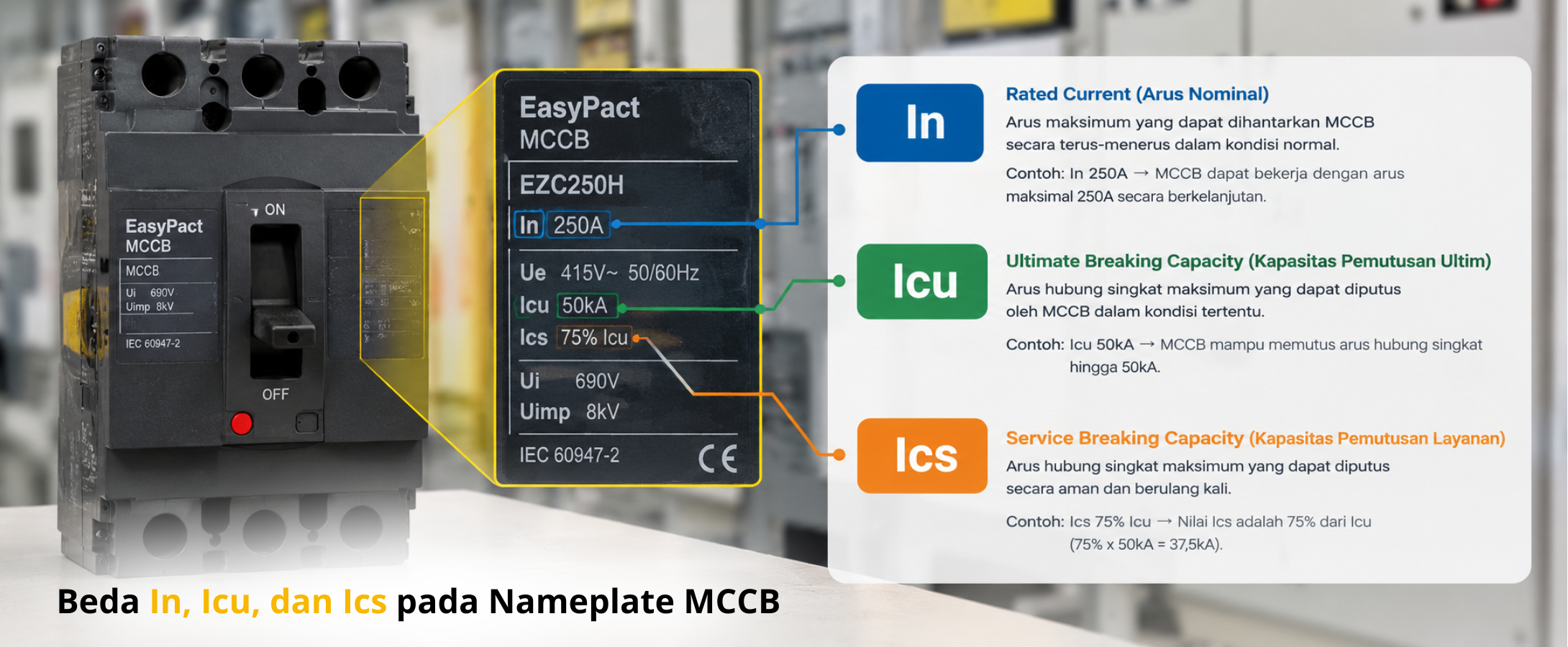
When choosing an MCCB, looking only at its frame size or ampere rating is not enough. An MCCB nameplate usually contains important information such as In, Icu, and Ics. Each parameter has a different meaning, especially when determining the MCCB's ability to handle normal current and short-circuit conditions. For technicians, engineers, and contractors, understanding these three ratings can make it easier to select the right MCCB for an electrical installation.
As an official Schneider Electric distributor, Listrik Kita provides original and warranted products for various electrical needs. Before choosing an MCCB, let us understand what In, Icu, and Ics mean on an MCCB nameplate.
Understanding In, Icu, and Ics on an MCCB Nameplate
What Is In on an MCCB?
In (Rated Current) is the rated current that indicates the MCCB's ability to carry electrical current continuously under normal operating conditions according to the product specifications.
For example, an MCCB may have an In rating of 250 A. This means the MCCB has a rated current of 250 A. This rating is an important consideration when selecting an MCCB based on the load and electrical system requirements.
However, In does not indicate the MCCB's short-circuit breaking capacity. For that information, we need to look at Icu and Ics.
What Is Icu on an MCCB?
Icu (Rated Ultimate Short-Circuit Breaking Capacity) is the ultimate short-circuit breaking capacity stated for an MCCB under specified test conditions and applicable standards.
Icu is usually expressed in kA, such as 25 kA, 36 kA, or 50 kA. The higher the potential short-circuit current in an installation, the more important it is to make sure that the MCCB's breaking capacity is suitable for the system.
For example, an MCCB may have an Icu of 36 kA. This value represents the ultimate breaking capacity declared by the manufacturer at a specified voltage and under specified conditions. Therefore, Icu should be considered together with the prospective short-circuit current at the installation point.
What Is Ics on an MCCB?
Ics (Rated Service Short-Circuit Breaking Capacity) refers to the service short-circuit breaking capacity stated by the manufacturer according to the applicable test requirements and standards.
Ics is also expressed in kA. This parameter is important because it provides information about the MCCB's short-circuit breaking capability under service conditions.
For example, if an MCCB nameplate shows Icu 36 kA and Ics 25 kA, the two values do not mean the same thing. Icu represents the ultimate breaking capacity, while Ics represents the service breaking capacity.
What Is the Difference Between In, Icu, and Ics?
In Shows the Rated Current
In is related to the MCCB's rated operating current under normal conditions. Its unit is ampere or A.
Icu Shows the Ultimate Breaking Capacity
Icu refers to the MCCB's ultimate short-circuit breaking capacity, which is generally expressed in kA.
Ics Shows the Service Breaking Capacity
Ics refers to the service short-circuit breaking capacity. It is also expressed in kA and provides information about the MCCB's breaking capability under specified service conditions.
In simple terms:
Parameter | Full Name | Function | Unit |
| In | Rated Current | Shows the MCCB's rated current | A |
| Icu | Rated Ultimate Short-Circuit Breaking Capacity | Shows the ultimate short-circuit breaking capacity | kA |
| Ics | Rated Service Short-Circuit Breaking Capacity | Shows the service short-circuit breaking capacity | kA |
Why Are In, Icu, and Ics Important When Choosing an MCCB?
Choosing an MCCB Based on the Electrical Load
The In rating should be selected according to the required load current and the characteristics of the electrical installation. An MCCB should not be selected based only on a rough estimate of the electrical load.
Matching Breaking Capacity to the Installation
In addition to In, Icu must be considered to make sure the MCCB's breaking capacity is suitable for the prospective short-circuit current at the installation point.
Considering Ics for Operational Reliability
Ics is also an important parameter when considering the MCCB's ability to deal with short-circuit conditions during service. Therefore, it is better not to focus on only one number on the nameplate.
Example of Reading an MCCB Nameplate
Suppose an MCCB has the following information:
In = 250 A
Icu = 36 kA
Ics = 25 kA
This means:
- In 250 A shows the MCCB's rated current.
- Icu 36 kA shows the rated ultimate short-circuit breaking capacity.
- Ics 25 kA shows the rated service short-circuit breaking capacity.
This example shows that each parameter provides different information. All three should be considered when selecting an MCCB for an electrical installation.
Common Mistakes When Reading an MCCB Nameplate
Assuming In Is the Short-Circuit Breaking Capacity
A common mistake is assuming that a 250 A MCCB can interrupt a short-circuit current of 250 kA. In fact, 250 A is the rated current, not the breaking capacity.
Looking Only at In When Choosing an MCCB
An MCCB with the correct rated current may not necessarily have the required short-circuit breaking capacity. Icu and Ics should also be checked.
Assuming Icu and Ics Are the Same
Icu and Ics are both related to short-circuit interruption, but they are different parameters. Therefore, the two values should not automatically be considered equal.
How to Read an MCCB Nameplate Correctly
Start by checking In to understand the rated current. Then, check Icu and compare it with the prospective short-circuit current at the installation point. After that, consider Ics as part of the service short-circuit breaking capacity requirements.
Besides these three parameters, also check the operating voltage, number of poles, trip unit, frequency, and other specifications listed for the product. MCCB selection should be based on the overall requirements of the electrical system, not just one number on the nameplate.
In, Icu, and Ics have different functions on an MCCB. In indicates the rated current, while Icu and Ics are related to the MCCB's short-circuit breaking capacity. Understanding these three ratings can help technicians, engineers, and panel users select an MCCB that better matches the requirements of an electrical installation.
If you are looking for original and warranted Schneider Electric MCCBs, you can purchase them through Listrik Kita. Choose the MCCB according to your system requirements and installation specifications to support electrical protection and system reliability.
