


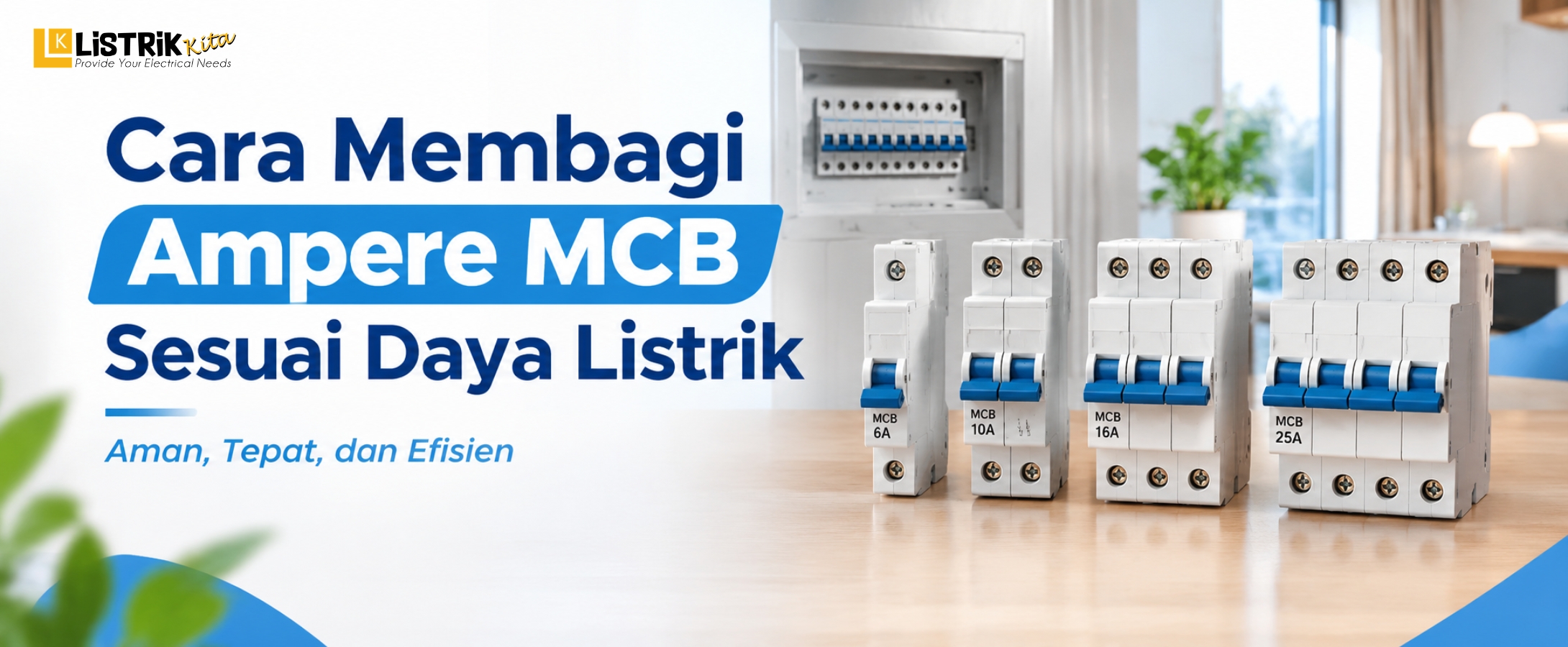
When planning a home electrical installation, dividing the wiring into several MCB circuits is an important step. Listrik Kita is an official Schneider Electric distributor that provides original and warranted electrical products for various applications. One of the commonly used products is the MCB, which helps protect electrical circuits from overcurrent and short circuits.
Dividing MCBs is not simply about adding or splitting ampere ratings equally. The available electrical capacity, main MCB rating, connected load, and cable size all need to be considered. With proper circuit division, each electrical circuit can be better protected and easier to manage.
Main Guidelines for Dividing MCB Ampere Ratings
Know the Electrical Capacity and Main MCB
The first step is to identify the available electrical capacity of the installation. Electrical capacity is commonly expressed in VA, while the MCB rating is expressed in Amperes or A.
For example, a 2,220 VA connection commonly uses a 10 A main MCB. A 1,300 VA connection uses a 6 A main MCB, while a 900 VA connection uses a 4 A main MCB.
The main MCB acts as the overall current limit of the installation. Therefore, even when several branch MCBs are installed, the total electricity consumption is still limited by the main MCB.
Match Each Branch MCB to Its Circuit
Branch MCBs are used to divide an electrical installation into several circuits. Each circuit can be arranged according to the area or type of load, such as lighting, power outlets, kitchen appliances, air conditioners, or other electrical equipment.
The MCB rating should be selected based on the connected load and the cable's capacity. Therefore, the MCB should not be selected only by looking at the room size or the number of electrical points.
Why Divide MCBs into Several Groups?
Separate Loads by Area
Dividing an installation into several groups makes the electrical system more organized. For example, one MCB can be used for lighting while another protects power outlets.
For installations with several high-power appliances, separating the circuits can also help distribute the loads more appropriately.
Make Protection and Maintenance Easier
If a problem occurs in one circuit, the corresponding branch MCB can trip without necessarily shutting down the entire installation.
This arrangement also makes troubleshooting easier because technicians can identify which circuit is experiencing a problem.
Match the MCB to the Load and Cable
The MCB and cable should be considered as part of the same protection system. Installing an MCB that is too large for the cable may prevent the cable from receiving proper protection during an overcurrent condition.
Before selecting an MCB, consider the type of load, estimated current, cable size, and installation conditions.
Basic Calculation for Dividing MCB Ampere Ratings
Calculate the Estimated Load of Each Group
A simple formula that can be used is:
I = P / V
I represents current in Amperes, P represents power in Watts, and V represents voltage in Volts.
For example, a 440-watt load at approximately 220 volts requires around 2 A of current. This simple calculation can help estimate the current requirement for each circuit.
Select an MCB Based on the Load and Cable
After estimating the load, the MCB rating should be selected while considering the cable's capacity. An MCB is not simply a switch. It is a protection device that must be appropriate for the circuit it protects.
Avoid choosing an MCB with a rating that is too high just to prevent frequent tripping. If the load exceeds the cable's capacity, the risk of excessive heating can increase.
Consider Loads Used at the Same Time
The calculation should also consider which appliances may operate simultaneously. Appliances such as air conditioners, water pumps, microwaves, water heaters, and rice cookers can add significant loads to the installation.
Understanding actual usage patterns can help create circuit groups that are more suitable for everyday needs.
Examples of Power and MCB Ampere Distribution
2,220 VA with a 10 Ampere Main MCB
For a 2,220 VA connection with a 10 A main MCB, the installation can be divided into two groups. One simple example is:
10 A Main MCB
↓
Group 1: 6 A MCB → Lighting and several power outlets
Group 2: 6 A MCB → Power outlets and household appliances
The branch MCBs provide protection for their individual circuits. Total electricity consumption is still limited by the 10 A main MCB.
2,220 VA Divided into 3 Groups
The installation can also be divided into three circuits:
10 A Main MCB
↓
Group 1: 4 A MCB → Lighting
Group 2: 6 A MCB → Living room and bedroom outlets
Group 3: 6 A MCB → Kitchen outlets and other appliances
Three separate groups can make the installation more organized and make individual circuit inspection and protection easier.
1,300 VA with a 6 Ampere Main MCB
For a 1,300 VA connection, the main MCB is 6 A. One example of dividing it into two groups is:
6 A Main MCB
↓
Group 1: 4 A MCB → Lighting and light loads
Group 2: 4 A MCB → Power outlets and household appliances
At this capacity, simultaneous use of several appliances should be considered because the total available capacity is more limited.
900 VA with a 4 Ampere Main MCB
For a 900 VA connection with a 4 A main MCB, the installation can be divided into two groups:
4 A Main MCB
↓
Group 1: 2 A MCB → Lighting and light loads
Group 2: 2 A MCB → Power outlets and light loads
This is only a simple example. The actual MCB rating should still be selected based on cable size, load type, and installation conditions.
Common Mistakes When Dividing MCBs
Assuming Branch MCBs Must Equal the Main MCB
Branch MCB ratings do not need to be added together to exactly match the main MCB rating. Branch MCBs protect individual circuits, while the main MCB limits the total current of the installation.
Installing an MCB That Is Too Large for the Cable
An MCB that does not match the cable capacity can reduce the effectiveness of the protection system. The cable's current-carrying capacity should always be one of the main considerations.
Dividing Loads Without Considering Simultaneous Use
Do not look only at how many appliances are connected to one group. Consider the power rating of each appliance and whether several devices may be operating at the same time.
Dividing MCB ampere ratings is not simply about splitting the numbers equally. The main reference is the available electrical capacity and main MCB, followed by the estimated load, cable size, and requirements of each circuit. Proper circuit division can make an electrical installation more organized and provide suitable protection for each circuit.
If you are looking for original and warranted Schneider Electric MCBs, Listrik Kita provides various MCB options for different electrical installation needs. Find and purchase the right Schneider MCB through ListrikKita.com.
