


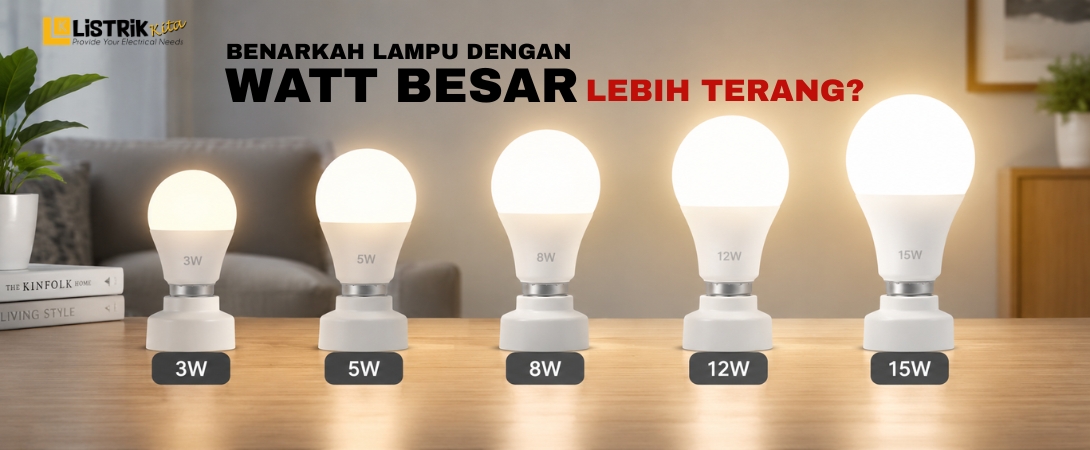
Many people assume that the higher the wattage of a lamp, the brighter the light it produces. However, wattage is not the only factor that determines how bright a lamp is. A lamp with lower power consumption can actually produce more light if it has better efficiency.
To understand this, we need to look at the difference between watts and lumens. Watts indicate how much electrical power a lamp uses, while lumens indicate how much light it produces. So, when choosing a lamp, do not focus only on the wattage shown on the packaging.
The Change from Incandescent Lamps to LED
Incandescent lamps produce light by heating a filament until it glows. During this process, most of the electrical energy is converted into heat, while only part of it is used to produce light.
LEDs work differently. LED semiconductor technology allows electrical energy to be converted into light more efficiently. As a result, LEDs can produce sufficient brightness while using much less power than incandescent lamps.
This is one of the reasons LED lamps are widely used as replacements for conventional lighting in homes, offices, shops, warehouses, and industrial areas.
Watt vs Lumen: What You Need to Know
What Is Watt?
Watt, or W, is a unit of electrical power. For lamps, the wattage indicates how much electrical power the lamp uses while it is operating.
The higher the wattage, the more electricity the lamp consumes. However, this does not automatically mean that the lamp produces brighter light.
What Is Lumen?
Lumen, or lm, is a unit used to measure the amount of light produced by a light source. Simply put, a higher lumen rating means the lamp produces more light.
For example, a 1,000-lumen LED lamp can produce more light than a 600-lumen LED lamp, even if the difference in wattage between the two is relatively small.
A Simple Analogy: Watt = Fuel, Lumen = Distance
To make this easier to understand, think of watts as the amount of fuel used by a vehicle, while lumens represent the distance the vehicle can travel.
A vehicle that uses more fuel does not necessarily travel farther if its engine is less efficient. The same idea applies to lamps.
A higher-wattage lamp is not necessarily brighter if its efficiency is low. On the other hand, a lower-wattage lamp can produce more light if it has better efficiency.
Why Is Wattage No Longer the Main Measure of Brightness?
Different Lighting Technologies Have Different Efficiency Levels
Each lighting technology has a different level of efficiency. One way to measure lamp efficiency is through luminous efficacy, which refers to the number of lumens produced for every watt of electrical power used.
The higher the lumens per watt, the more efficiently the lamp converts electrical energy into light.
Incandescent vs LED: A Real-World Comparison
As a simple example, a 60-watt incandescent lamp can provide a similar level of illumination to an LED lamp using around 8 to 10 watts, depending on the product specifications.
This comparison shows that lower power consumption does not necessarily mean dimmer light. LED technology makes it possible to use less electricity while still achieving good illumination.
Semiconductor Technology Allows LEDs to Produce More Light with Less Power
One of the main advantages of LED lighting comes from its semiconductor technology. This process allows electrical energy to be used more effectively than in traditional incandescent lamps.
That is why, when choosing an LED lamp, consumers should consider both lumens and watts. Lumens help indicate how much light the lamp produces, while watts help estimate its electricity consumption.
How to Choose the Right Lamp Based on Lumens
Calculate the Lighting Needs of the Room
Every room has different lighting requirements. Bedrooms, workspaces, kitchens, shops, warehouses, and outdoor areas do not necessarily need the same level of illumination.
The size of the room should also be considered. The larger the area that needs to be illuminated, the greater the total amount of light required.
Check Luminous Efficacy or Lumens per Watt
Besides looking at lumens, pay attention to the lamp's efficiency. For example, a 10-watt lamp that produces 1,000 lumens is more efficient than a 15-watt lamp producing the same amount of light.
By comparing lumens and watts, consumers can determine which lamp can provide lighting more efficiently.
Match the Lamp to the Purpose of the Room
The lamp should be selected based on the activities performed in the room. Work areas usually need sufficient lighting to make tasks easier and more comfortable. Bedrooms and relaxation areas, on the other hand, may be better suited to softer lighting.
For outdoor areas such as yards or parking areas, the type of lamp and required light level should also be adjusted to the surrounding conditions.
Common Mistakes When Buying Lamps
Looking Only at Wattage on the Packaging
Choosing a lamp based only on wattage is a common mistake. Two lamps with the same wattage may produce different amounts of light.
For this reason, always check the lumen rating before deciding which lamp to buy.
Ignoring Color Temperature or Kelvin and CRI
Besides lumens and watts, pay attention to Kelvin (K) to understand the color of the light. Warm white creates a warmer and more comfortable atmosphere, while cool white and daylight tend to create a brighter and fresher environment.
CRI, or Color Rendering Index, is also important because it indicates how accurately a lamp displays the colors of objects compared with a reference light source. For certain areas, a higher CRI can help objects appear more natural in color.
Practical Tips for Consumers
Read the Energy Label and Lumen Specifications
Before buying a lamp, make it a habit to read the information on the packaging. Check the lumen rating to understand the amount of light produced and the wattage to understand how much electrical power the lamp uses.
This makes it easier to compare different products objectively.
Prioritize High-Efficiency Lamps to Save Electricity
If you want good lighting while keeping electricity consumption under control, choose a lamp with high efficiency. Compare the amount of light produced with the amount of electrical power used.
So, a higher-wattage lamp does not automatically produce brighter light. When determining brightness, lumens are one of the most important specifications to consider, while watts can be used to understand power consumption. By understanding the difference between the two, you can choose a lamp that matches your lighting needs while using energy more efficiently.
If you are looking for a variety of LED lamps for your home, office, shop, or other applications, you can find and purchase them at Listrik Kita.
