


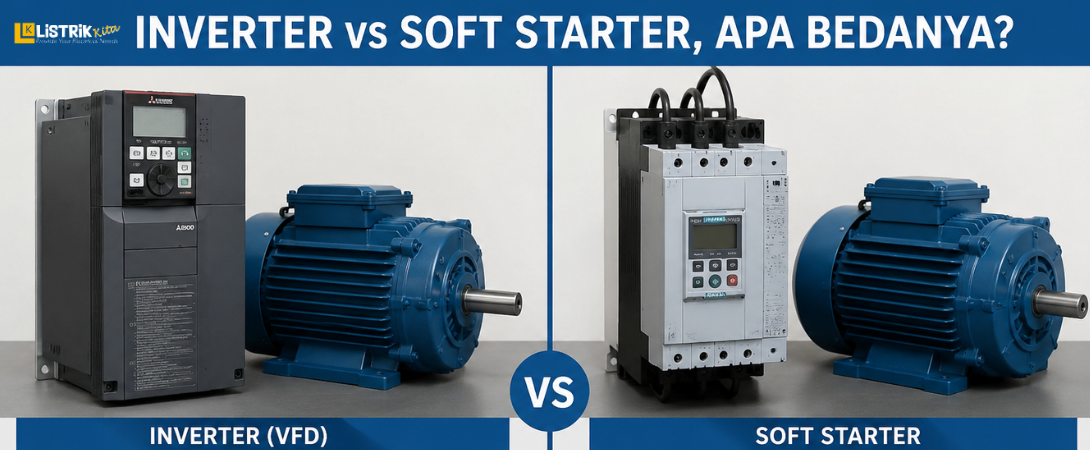
Electric motors play an important role in industrial, commercial, and building applications. To improve performance and protect motors, many users rely on devices such as inverters and soft starters. Although they are often considered similar, these two solutions serve different purposes in motor operation.
Understanding the difference between an inverter and a soft starter can help you choose the right solution for your system while improving efficiency and reducing operating costs.
What Is an Inverter?
Understanding Inverters in Motor Control Systems
An inverter, also known as a Variable Speed Drive (VSD) or Variable Frequency Drive (VFD), is a device used to control the speed of an electric motor by adjusting the frequency and voltage supplied to it.
This allows the motor to operate at different speeds based on process requirements, providing greater flexibility than traditional motor systems.
How Does an Inverter Work?
An inverter converts alternating current (AC) into direct current (DC) and then converts it back into AC at a controlled frequency. By changing the frequency, the inverter can adjust the motor speed as needed.
Because of this capability, inverters are widely used in applications that require precise speed control.
Benefits of Using an Inverter
Some key advantages of using an inverter include:
- Lower energy consumption in many applications.
- Accurate motor speed control.
- Reduced mechanical stress during startup.
- Improved production efficiency.
- Extended lifespan of motors and connected equipment.
What Is a Soft Starter?
Understanding Soft Starters
A soft starter is a device designed to reduce the high current surge that occurs when a motor starts. When a motor is started directly, the initial current can be significantly higher than its normal operating current.
A soft starter minimizes this issue by gradually increasing the voltage supplied to the motor until it reaches full speed.
How Does a Soft Starter Work?
The device slowly increases voltage during the startup process, allowing the motor to accelerate smoothly instead of starting abruptly.
This approach not only reduces inrush current but also helps minimize mechanical shock that can lead to premature wear and tear.
Benefits of Using a Soft Starter
Some common advantages of soft starters include:
- Reduced inrush current during startup.
- Lower mechanical stress on equipment.
- Simple installation and operation.
- Lower initial investment cost compared to inverters.
- Suitable for fixed-speed applications.
Differences Between Inverters and Soft Starters
Comparison Table
Category | Inverter (VSD/VFD) | Soft Starter |
| Main Function | Controls motor speed and torque during operation | Reduces current surge during startup and shutdown |
| Speed Control | Yes, motor speed can be adjusted | No speed control during operation |
| Working Principle | Adjusts frequency and voltage supplied to the motor | Gradually increases voltage during startup |
| Complexity | More advanced with multiple control parameters | Simpler and easier to configure |
| Cost | Generally higher due to advanced features | Usually more affordable |
When Should You Use an Inverter?
An inverter is the best choice when variable motor speed is required. Common applications include pumps, industrial fans, conveyors, HVAC systems, and manufacturing processes that require precise motor control.
It is also popular for its potential to improve energy efficiency, especially in applications with varying load demands.
When Is a Soft Starter the Better Option?
A soft starter is ideal for applications that operate at a constant speed and do not require speed adjustment. It is commonly used with pumps, blowers, compressors, and other industrial equipment that benefit from a smooth startup process.
For many projects, it also offers a more cost-effective solution.
Which Is Better: Inverter or Soft Starter?
Choose Based on Your Application
Each device is designed for different purposes, making the ideal choice dependent on the application. The right choice depends on the operational requirements of your motor system.
If you need speed control, energy savings, and operational flexibility, an inverter is the better option. If your main goal is to reduce startup current while keeping costs lower, a soft starter may be the ideal solution.
Mistakes to Avoid When Selecting Motor Control Devices
One common misconception is assuming that inverters and soft starters serve the same purpose. In fact, each device is designed for a specific application. Understanding your system requirements is essential before making a decision.
Both inverters and soft starters play important roles in motor performance and protection, but they are designed for different functions. Inverters excel at speed control and energy efficiency, while soft starters focus on reducing startup current and mechanical stress. By understanding these differences, you can select the most suitable solution for your application.
If you are looking for high-quality inverters and soft starters from trusted brands, visit Listrik Kita. Explore a wide range of motor control solutions designed to improve the efficiency and reliability of your electrical systems.
