


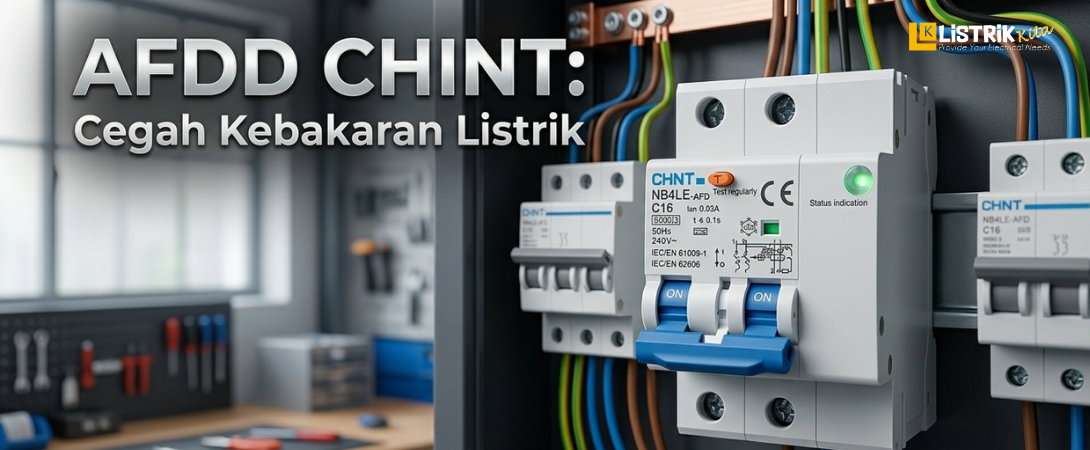
Electrical fires remain one of the main causes of property loss and casualties in many countries, including Indonesia. Many people assume that standard circuit breakers like MCB (Miniature Circuit Breaker) are enough to protect their homes from fire hazards. But in reality, MCB only responds to overloads or major short circuits. There is one hidden danger that MCB cannot detect, which is high voltage electrical sparks that appear suddenly. This is where the Arc Fault Detection Device (AFDD) becomes very important. This article will discuss why AFDD can minimize the risk of electrical fires, how it works, its two types, and the advantages of the CHINT NB4LE-AFD series.
What Is Arc Fault Detection?
To understand AFDD, we first need to know the term Arc Fault. In the world of electricity, an Arc Fault is a phenomenon where electrical sparks jump between two conductors due to an air gap or damaged insulation. This spark is different from a regular short circuit because the current is often unstable and not large enough to trigger the MCB.
Why Is This Phenomenon So Dangerous?
When an electrical spark occurs, the temperature at the contact point can soar to more than 6,000 degrees Celsius. This kind of heat can burn cable insulation, accumulated dust, or nearby wooden materials in just seconds. Imagine a small spark behind the wall of your bedroom. Without you knowing, a fire could grow large before you even smell smoke. AFDD is designed to detect these abnormal sparks before they turn into flames. In other words, this device works like a smoke detector that directly cuts off the electricity, not just giving a warning after a fire has already started.
Common Causes of Arc Fault
These electrical sparks often come from small, everyday things that we might ignore, such as cables crushed under heavy furniture, loose outlet connections due to age, or wiring pierced by a nail during wall installation.
How Does an Arc Fault Detector Work?
A common question is how a small device like an AFDD can tell the difference between a dangerous spark and the normal operation of electrical tools like a drill motor or a vacuum cleaner. The answer lies in advanced microprocessor technology.
Real Time Waveform Analysis
AFDD continuously monitors the waveform of the electrical current on the circuit it protects. Under normal conditions, this waveform is smooth and regular. But when an Arc Fault occurs, the waveform becomes chaotic, full of typical high frequency distortion.
This device uses smart algorithms to distinguish between harmless sparks, for example from an electric motor's brushes, and sparks that indicate insulation damage or a broken wire. When a pattern that signals fire danger is detected, AFDD will immediately cut off the electricity in less than one second. This speed prevents enough heat from building up to start a fire.
What Are the 2 Types of Arc Fault Detectors?
In practice, AFDD is designed to protect against two different damage scenarios. Understanding both types will help you see how comprehensive the protection really is.
1. Series Arc Fault
The first type occurs within a single conductor path. An example is a cable that is almost broken, only held together by a few copper strands. The electric current is forced to jump across the gap at the breaking point.
The characteristic of this type is that the flowing current is usually lower than the normal load current. A standard MCB will not react because it does not detect an overload. Common causes include loose screw terminals, wires that break because they are bent too often, or wiring that is decades old.
2. Parallel Arc Fault
Different from the first type, the second type occurs between two different conductors, for example between the Live and Neutral wires, or between Live and Ground.
The characteristic of this type is that even though the released energy is very high, the flowing current is often not large enough to activate the instant trip mechanism of a conventional MCB. As a result, the sparking can continue for a long time. Common causes include insulation that has thinned with age, wires crushed under heavy objects, or wiring pierced by a nail during drywall installation.
With its ability to detect both types of electrical sparks, AFDD is the only device that can truly close the safety gap left by ordinary MCBs and RCDs.
CHINT NB4LE-AFD: Reliable 3 in 1 Protection
After understanding the urgency of AFDD, the next step is to choose the right product. CHINT, as a leading global electrical equipment manufacturer, presents a superior solution through the NB4LE-AFD series. This device is not just an ordinary AFDD, but rather an integrated protection center.
Three Functions in One Unit
The main advantage of the NB4LE-AFD is its ability to combine three layers of protection in one compact module. The first function is Arc Fault Protection, which detects and stops electrical sparks that can cause fires, both series and parallel types. The second function is Residual Current Protection or RCD, which protects humans from fatal electric shocks if current leaks to the ground. The third function is Overcurrent Protection or MCB, which protects the circuit from damage due to short circuits and overloads.
In other words, installing one NB4LE-AFD unit is the same as installing three different safety devices at once. This saves space in the distribution panel and also reduces installation costs.
Smart Feature for Easy Diagnosis
CHINT also equips the NB4LE-AFD with colored LED indicators that tell you what type of fault last occurred. Did the device trip because of the first type of spark, the second type, or because of a current leak? This information is very valuable for technicians to make precise repairs without having to guess. Its sensitivity level has also been adjusted to international standards IEC EN 62606, so its reliability is guaranteed in distinguishing dangerous sparks from normal operation of household appliances.
CHINT recommends installing the NB4LE-AFD especially on final circuits that have a high fire risk, such as sleeping areas including hotel rooms, dormitories, hospitals, and children's rooms, old buildings with aging wiring, and locations with flammable materials like warehouses or wood shops.
Electrical fires are not an unavoidable accident. They are a risk that can be prevented with the right technology. MCB alone is not enough to protect your home from the silent threat of electrical sparks. With AFDD, especially the CHINT NB4LE-AFD, you get complete protection against sparks, electric shocks, and short circuits in one elegant device.
Get the CHINT Arc Fault Detection Device (AFDD) NB4LE-AFD series only at Listrik Kita. Visit the official Listrik Kita website and create an environment that is truly safe from the threat of electrical fires. Do not delay the safety of your family and your assets. Order the NB4LE-AFD at Listrik Kita today.
