


In today’s industrial world, where reliability and safety are top priorities, electrical connections cannot rely on ordinary household plugs. Work environments such as factories, construction sites, and mining areas often face extreme conditions, including dust, moisture, and heavy vibrations. In these situations, a durable and secure electrical connector system is essential.
This is where Industrial Plugs and Sockets play a critical role. These components are designed to deliver safe, stable, and long-lasting power connections even in the harshest industrial settings. This article explains their types, technical specifications, and real-world applications across various industrial sectors.
Types of Industrial Plugs and Sockets
Industrial plugs and sockets come in several configurations, each designed to meet specific power and safety requirements. The differences generally lie in the number of pins, phase systems, and built-in safety features.
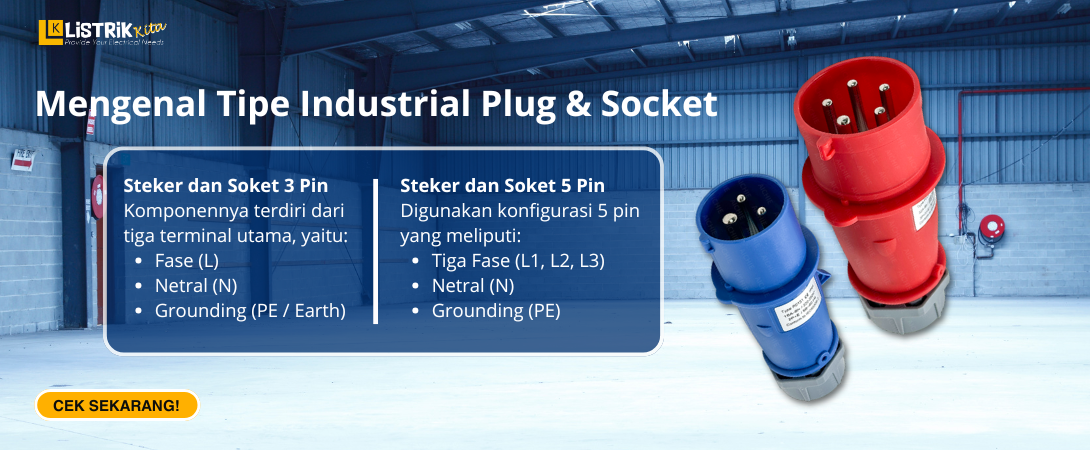
3-Pin Plug and Socket
The 3-pin configuration is the most basic and commonly used in single-phase systems.
It consists of three main terminals:
-
Live (L)
-
Neutral (N)
-
Earth (PE or Ground)
This type is typically used for low to medium power equipment such as portable drills, site lighting, and small generators. Despite its simple design, it ensures stable and safe power delivery for everyday industrial needs.
5-Pin Plug and Socket
The 5-pin configuration is designed for three-phase (3-phase) power systems and includes:
-
Three live wires (L1, L2, L3)
-
Neutral (N)
-
Earth (PE)
The addition of a neutral wire allows the system to power both three-phase and single-phase equipment simultaneously. This type is widely used in large industrial environments to power heavy machinery such as CNC machines, compressors, conveyors, and other motor-driven equipment.
Interlocked Socket
A key safety feature that distinguishes industrial sockets from standard ones is the mechanical interlock system.
This mechanism is designed to:
-
Prevent unplugging under load: The plug cannot be removed when the switch is in the “ON” position.
-
Ensure safe connection sequence: Power only flows once the plug is fully inserted, and it disconnects automatically before the plug can be removed.
This system is crucial in preventing electrical arcing that can cause fires, especially in high-risk environments such as refineries, chemical plants, and storage areas containing flammable materials.
Technical Specifications of Industrial Plugs and Sockets
Understanding technical specifications is vital to ensure the correct and safe selection of industrial plugs and sockets. The following parameters are the most important to consider.
Current Rating
The current rating indicates the maximum amount of electrical current that can safely pass through the connector.
Common ratings include 16A, 32A, 63A, and 125A.
Selecting the proper current rating based on the power requirements of your equipment is essential. Choosing incorrectly may cause overheating or damage to the components.
Voltage Rating
This indicates the highest voltage the device can safely withstand.
Examples include:
-
230V for single-phase systems
-
400V for three-phase systems
-
Up to 690V for heavy-duty industrial use
Always ensure the voltage rating of the plug and socket matches the supply voltage at your facility for safe and optimal operation.
Frequency Rating
Most electrical systems operate at either 50Hz or 60Hz, depending on regional standards. Although most modern industrial plugs and sockets support both frequencies, it is important to verify compatibility to prevent electrical imbalance.
IP Rating (Ingress Protection)
The IP rating measures how well the device is protected against dust and water. The first number shows how well it keeps dust and other solids out, and the second number shows how well it keeps water and other liquids out.
For example:
-
IP44: Resistant to water splashes from any direction, suitable for outdoor use.
-
IP67: Completely dust-tight and can withstand temporary immersion in water, ideal for washdown or highly humid environments.
The higher the IP rating, the better the protection, which is crucial in heavy industrial settings.
Applications of Industrial Plugs and Sockets
Because of their flexibility and reliability, industrial plugs and sockets are essential across many industries.
Manufacturing
In manufacturing facilities, these connectors are used to:
-
Power portable or movable machines such as welding robots or assembly units.
-
Provide safe and quick connection points for maintenance or testing tools.
Their main advantage lies in easy installation and their ability to handle high electrical loads safely.
Construction
Construction sites are harsh, unpredictable, and exposed to dust, water, and impact.
Industrial plugs and sockets in this sector supply power to heavy equipment such as water pumps, portable cranes, and concrete vibrators.
Models with impact-resistant housings and high IP ratings are preferred to ensure durability and worker safety.
Mining
Safety is the top priority in the mining industry.
The plugs and sockets used here are typically rugged and explosion-proof.
They supply power to underground mining equipment, lighting systems, and dewatering pumps in extreme conditions.
Oil and Gas
Oil rigs and refineries operate in highly hazardous environments filled with flammable gases and vapors.
For this reason, all plugs and sockets must be fire- and explosion-proof (ATEX or Ex certified).
They are used to power drilling equipment, refinery systems, and other electrical installations in processing areas.
Renewable Energy
In renewable energy sectors such as solar farms and wind turbines, industrial plugs and sockets serve key roles in:
-
Maintenance: Allowing safe disconnection during equipment servicing.
-
Modular installation: Simplifying the interconnection of solar panels or turbine systems.
Industrial plugs and sockets are far more than simple electrical connectors. They are engineered components built to ensure safety, reliability, and efficiency across all types of industrial operations.
By understanding their types, technical specifications, and practical applications, you can make smarter decisions when choosing the right electrical connection solution for your facility.
The right choice not only enhances system performance but also helps prevent hazards and ensures uninterrupted industrial productivity.
Find the industrial plug and socket that suits your needs at Listrik Kita.
