


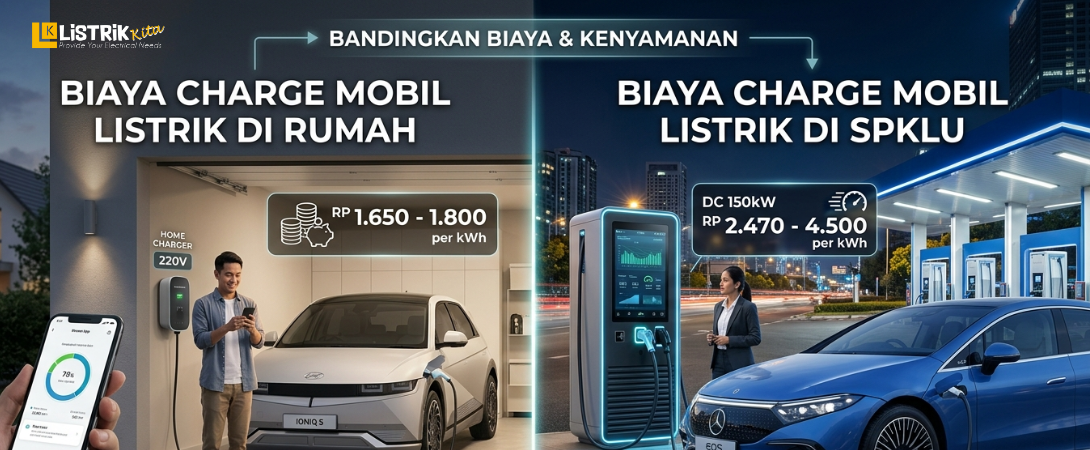
Many people who are thinking about buying an electric car often ask the same question: how much does it really cost to charge an electric car once? Is it truly cheaper than filling up with gasoline? Also, how long does it take until the battery is full?
This article will explain the cost comparison between charging at home and at public charging stations (called SPKLU in some countries). It will also talk about the charging time based on the method you choose.
Calculating the Cost of Charging an Electric Car at Home
A Simple Formula to Calculate Home Charging Costs
To figure out how much you spend when charging your electric car at home, you just need to multiply the battery size (in kWh) by your home electricity rate per kWh. For example, if your car has a 50 kWh battery and your home electricity rate is $0.12 per kWh, then the cost for a full charge is:
50 kWh × $0.12 = $6.00
That amount is much cheaper than buying gasoline for a trip of 300 to 400 kilometers.
Cost Examples for Popular Electric Car Models
To make things clearer, here are some examples for electric cars that are common in many markets:
- Small city electric car (battery 26.7 kWh): around $3.20 for a full charge.
- Mid size electric car (battery 58 kWh): around $7.00 for a full charge.
- Popular SUV style electric car (battery 60.5 kWh): around $7.30 for a full charge.
Keep in mind that you rarely charge from 0% to 100%. Most of the time, you charge from 20-30% up to 80-90%. So the actual cost is usually lower than these numbers.
Does Your Home's Power Capacity Affect the Cost?
Your home's power capacity (for example, low or high amperage) does not change the cost per kWh. What changes is the charging speed. The higher your home's power capacity, the faster your car charges. But the final cost stays the same because the rate per kWh is identical.
Cost of Charging at Public Stations vs at Home
Difference in Pricing Structure
If you charge at home, you only pay the standard electricity rate. But at public charging stations, it is usually more expensive. Public station rates often range from 1.5 to 2 times your home rate, plus possible parking fees or service fees in some locations.
For a 50 kWh battery, you might pay between 20% to 30% more at a public station compared to charging at home.
When Does It Make Sense to Use a Public Station?
Even though it is more expensive, there are situations where a public station is the right choice:
- When you are traveling a long distance, like between cities, and your battery is running low on the road.
- For people who live in apartments or houses with small power capacity that cannot support a home charger installation.
Fast Charging (DC) vs Regular Charging (AC) at Public Stations
Besides price, you also need to consider the type of charger:
- DC fast charging is more expensive per kWh, but the charging time is very short, around 30 to 60 minutes to go from 0% to 80%.
- AC charging, which you often find at malls or office parking lots, is cheaper but the process is much slower.
How much time do you need to charge an electric car?
Charging Time Based on Charging Method
How fast your car charges really comes down to how powerful the charger is. Here is a comparison for a 50 kWh battery going from 0% to 80%:
| Charging Method | Power | Time |
| Regular home outlet | 2.3 kW | around 17 hours |
| Home wall charger (7.4 kW) | 7.4 kW | around 5.5 hours |
| Public AC charger (22 kW) | 22 kW | around 2 hours |
| Public DC fast charger (50 kW) | 50 kW | 45 to 60 minutes |
| Ultra fast charger (150 kW or more) | 150 kW | around 20 minutes |
Factors That Affect Charging Time
Not every charging session runs fast. There are a few things that can cause delays in the process:
- Starting battery level (State of Charge). Going from 0% to 80% battery takes way less time than going from 80% to 100%.This is because the system automatically reduces power to protect the battery.
- Battery temperature. If the battery is too hot or too cold, the system will lower the charging speed for safety.
- The car's onboard charger capacity. Even if you plug into a 22 kW charger, if your car only supports 3.3 kW (older models), the charging will still be slow.
- How many cars are charging at the same station. Some stations share power among several vehicles. So the speed per car can go down when more cars are plugged in.
Looking at all the comparisons above, it is clear that the cheapest way to charge an electric car is at home. Not only is the rate per kWh lower, but you also avoid waiting in line or paying extra parking fees. For daily needs like going to work, taking kids to school, or grocery shopping, charging overnight at home is more than enough.
To make home charging work well and safely, you need the right EV charging equipment that matches your home's electrical system. Do not just use a regular power outlet, because that can cause wires to overheat and create a fire risk.
Visit Listrik Kita to find a variety of quality home EV wall chargers. They come with overload protection and an official warranty.
