


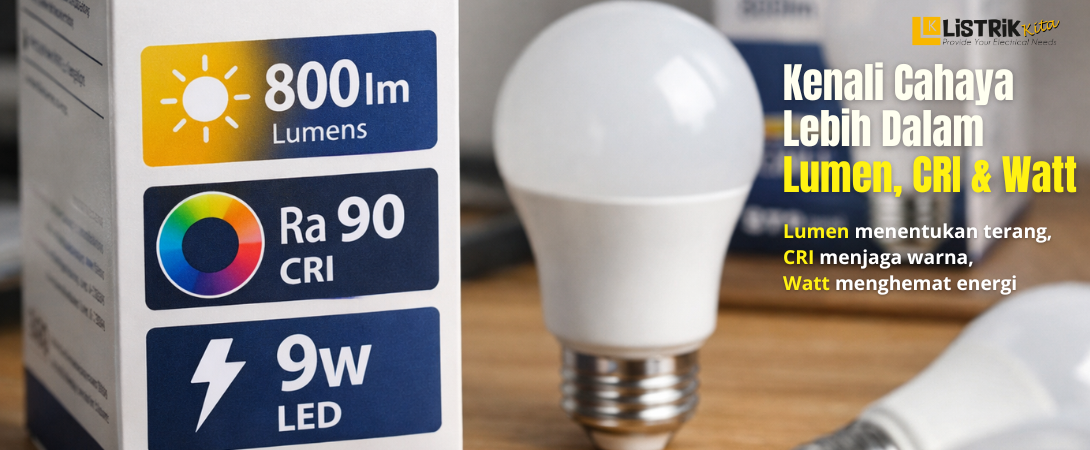
Have you ever felt confused when buying a new light bulb? You're probably familiar with the term Watt, which is often associated with how bright a light is. However, with the arrival of LED technology, the way we choose lighting has fundamentally changed. Two new terms, Lumens and CRI, now appear on light bulb packaging and are just as important. Understanding the fundamental difference between Lumens, Watts, and CRI is the key to getting lighting that is not only powerful, but also comfortable for the eyes, energy-efficient, and able to display colors accurately. This article will guide you to understand this "important trio" in the world of lighting, so you'll never choose wrong again.
1. Understanding Watt: A Measure of Power, Not Light Intensity
For decades, we were used to choosing bulbs based on the Watt number. "Just buy the 60 Watt one, so the light is strong," is roughly the common assumption. However, this is a misunderstanding that needs to be corrected. Watt is actually not a measure of light intensity, but of power consumption.
What Does Watt Really Mean?
The unit Watt (W) technically measures the rate of electrical energy consumption. Simply put, it indicates how much electrical power is "consumed" by a light bulb to be able to turn on. With old incandescent bulbs, there was indeed a simple correlation: the higher the Watt, the stronger the bulb's light and the higher your electricity bill. This happens because incandescent bulbs convert most of their energy into heat, not light.
The Role of Watt in the Era of Smart LED Lights
This is where the revolution happens. LED (Light Emitting Diode) technology is extremely efficient at converting electricity into light. The direct relationship between Watt and light intensity is broken. Now, you can get very strong light from a bulb that requires very little power. For example, to get a light level equivalent to a 60 Watt incandescent bulb, you only need an LED bulb with a power of just 8-10 Watts. Therefore, in a modern context, Watt has become the primary indicator of energy efficiency and estimated operating cost, not a benchmark for light strength. Buying a low-Watt bulb means you save energy and reduce your monthly electricity bill.
2. Understanding Lumens: The True Unit for Light Output
So, if Watt isn't the measure of light strength, what should we look at? The answer is Lumens (lm). This is the unit that scientifically and accurately describes how "strong" a light source's output is.
The Definition of Lumens You Need to Understand
Lumen is defined as the total amount of visible light emitted by a light source in all directions. Imagine lumen as the "flow" of light coming out of the bulb. The higher the lumen number, the greater the flow of light, and consequently, the stronger the light that bulb produces for our eyes. When you read the specifications on an LED bulb package, pay attention to its lumen number. This is the standard benchmark you can use to compare between brands and types of bulbs.
The Symbiotic Relationship Between Lumens and Watt: Light Efficiency
A key concept that emerges from this understanding is Luminous Efficacy or Lighting Efficiency, measured in Lumens per Watt (lm/W). This number shows how cleverly a bulb converts electrical energy (Watt) into light (Lumens). A good LED bulb can have an efficacy of over 100 lm/W, while an old incandescent bulb is only about 15 lm/W. So, your focus shifts: instead of looking for a "10 Watt LED", look for an "800 Lumen LED". With the same lumen output, a bulb with lower Wattage is a more efficient choice.
3. Understanding CRI: The Determinant of Color Quality and Comfort
Sometimes a room feels sufficiently lit (high Lumens), but the colors of objects in it look odd, dull, or unnatural. This is where the role of CRI (Color Rendering Index) becomes crucial. CRI is the parameter that determines the quality of the light, not its quantity.
What is CRI and How Does it Work?
CRI is a numerical scale from 0 to 100 that measures how well an artificial light source reveals the true colors of an object compared to natural lighting (like midday sunlight), which is considered perfect (CRI 100). Light with a high CRI (≥80) will make red look truly red, green appear fresh green, and human skin look healthy. Conversely, light with a low CRI will "clip" some color spectra, making everything look flat, washed out, or change tone.
Why is High CRI Important for Everyday Life?
High-quality lighting directly impacts comfort, productivity, and aesthetics. High CRI is highly recommended for:
-
Work and Hobby Areas: Such as the kitchen (to judge the freshness of ingredients), a makeup vanity (so makeup matches its color in outdoor light), and art or craft studios.
-
Retail and Commercial Spaces: Clothing stores, boutiques, or car showrooms need high CRI so products look attractive and their colors don't disappoint customers when seen elsewhere.
-
Residential Homes: In general, bulbs with CRI ≥80 will create a more comfortable, vibrant atmosphere and reduce eye strain compared to bulbs with low CRI.
Choosing the ideal bulb today is about balancing these three pillars: Light Output (Lumens), Efficiency (Watt), and Color Quality (CRI). For general lighting in a living room or bedroom, prioritize Lumens suitable for the room size and choose a low Watt for efficiency. For areas where color accuracy is important, like the kitchen or a work desk, make sure you choose a bulb with a CRI of at least 80, and ideally above 90.
When shopping, don't be easily tempted by claims of "equivalent to a 60 Watt bulb". Read the packaging carefully: look for the Lumen (lm) number for light strength, Watt (W) for efficiency, and CRI (Ra) for color quality. By understanding the role of each, you will become a smart consumer and can create the perfect home atmosphere with the right lighting.
Ready to apply this knowledge to choose the best bulbs? Find a variety of LED lighting options with clear and trustworthy Lumens, CRI, and Watt specifications only at Listrik Kita. We provide quality lighting products from leading brands that are not only powerful and efficient, but also comfortable for your eyes every day.
