


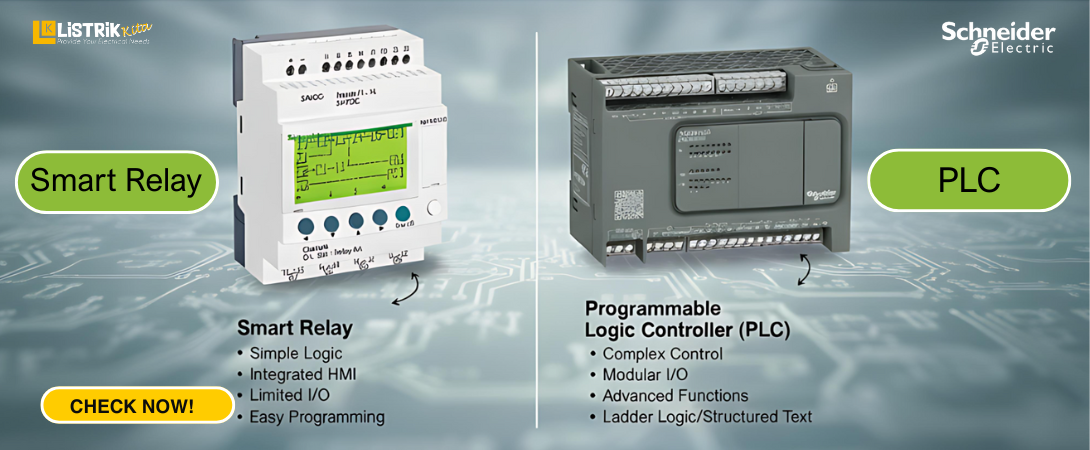
In the world of industrial automation and modern control systems, two devices are often compared: the Smart Relay and the Programmable Logic Controller (PLC). At first glance, they may seem similar since both are used to automatically control electrical systems or machines. However, behind their similarities lie fundamental differences that affect performance, cost, and scalability.
Understanding these differences is essential to help you choose the most efficient control solution for your specific application. This article explains the comparison between Smart Relay and PLC in detail, including their definitions, functions, and real-world applications.
Smart Relay vs PLC: A Brief Overview
Before diving into the differences, it’s important to understand what Smart Relay and PLC actually are.
What Is a Smart Relay?
A Smart Relay, also known as a Control Relay, is a compact and integrated control device. It is designed to replace conventional relay circuits that are usually complex and require a lot of wiring space.
Smart Relays are suitable for simple automation tasks, where basic logic functions such as timers, counters, and ON/OFF control are sufficient.
Programming a Smart Relay is usually simple and can be done either through basic software or directly from the built-in front panel. The programming language used is often a simplified version of Ladder Logic, making it easy to learn even for technicians without advanced programming skills.
In other words, a Smart Relay can be compared to a feature phone. It doesn’t have all the advanced features of a smartphone, but it performs its main tasks well, is easy to use, and affordable.
What Is a Programmable Logic Controller (PLC)?
Unlike a Smart Relay, a PLC (Programmable Logic Controller) is an industrial-grade computer designed to control machines or processes with higher levels of complexity.
A PLC has much stronger processing power and can handle hundreds or even thousands of input/output (I/O) points at the same time. It can execute advanced control algorithms, data communication, and complex mathematical functions efficiently.
PLC programming is done using specialized software with standard programming languages defined by IEC 61131-3, such as Ladder Diagram, Structured Text, and Function Block Diagram. The primary users of PLCs are system integrators, engineers, and industrial specialists working with medium to large-scale automation systems.
If we compare it to Smart Relay, a PLC is like a flagship smartphone. It offers high performance, flexibility, and adaptability for a wide range of industrial needs.
Key Differences Between PLC and Smart Relay
Below are several important aspects that distinguish Smart Relay and PLC in terms of function and technical characteristics.
1. Versatility and Scalability
-
Smart Relay:
Typically comes with a limited number of I/O points, usually between 10 and 40. It’s not designed for expansion and lacks modularity. Smart Relay is suitable for fixed applications that are unlikely to change in the future. -
PLC:
PLCs are highly flexible and can be scaled according to system requirements. From small Micro PLCs to large modular systems, users can easily add I/O modules, communication modules, or special function units when needed.
2. Accuracy and Complexity
-
Smart Relay:
Works well for basic logic control such as ON/OFF, timers, and counters. However, it has limitations when dealing with mathematical calculations, data processing, or precise PID control. -
PLC:
Offers higher processing power and can handle floating-point operations, PID control, and data processing with great accuracy. PLCs are ideal for industries that require high stability and precision.
3. Reliability
Both devices are reliable but are intended for different levels of use.
-
Smart Relay: Reliable for light and simple applications, but performance may drop if used beyond its capacity.
-
PLC: Built with industrial-grade components that can withstand extreme temperatures, dust, and vibration. PLCs can run continuously for years with a high Mean Time Between Failure (MTBF) rate.
4. Cost Efficiency
-
Smart Relay:
Has a lower purchase cost and is inexpensive to install and program. It’s perfect for small projects with limited budgets and simple automation needs. -
PLC:
Requires a higher initial investment but becomes more cost-effective in the long term. When the system grows, you only need to add new modules instead of replacing the entire setup.
5. Integration and Communication
-
Smart Relay:
Usually supports only basic communication ports like RS-485 with specific proprietary protocols. It can connect to simple HMI panels, but integration with higher-level systems is limited. -
PLC:
Supports various industrial communication protocols such as Ethernet/IP, Profinet, and Modbus TCP/IP. PLCs can easily integrate with HMI, SCADA, MES, and even IT databases for centralized monitoring and control.
6. Response Time
-
Smart Relay:
Offers a fast enough response time for simple applications like small conveyors, pumps, or lighting systems. -
PLC:
Has a much shorter scan time, often measured in milliseconds. This is crucial for high-speed and precise operations such as packaging machines, robotics, or motion control.
Common Applications: When to Use PLC and Smart Relay
Once you understand the differences, it becomes clearer when to choose a Smart Relay or a PLC.
Typical Smart Relay Applications
-
Automatic lighting systems in buildings or gardens
-
Escalator, lift, or automatic door systems
-
Gate and access control systems
-
Control panels for small machines like stamping machines
-
Replacement for traditional relay panels that need simple flexibility
Typical PLC Applications
-
Large-scale manufacturing process control
-
Automated conveyor systems in factories or warehouses
-
High-speed packaging and palletizing machines
-
Water treatment systems with PID control
-
SCADA systems for plant-wide monitoring and control
Choosing Between Smart Relay and PLC
Your choice between Smart Relay and PLC depends on application complexity, budget, and long-term goals.
Choose a Smart Relay if:
-
The application is simple with limited I/O points
-
There is no need for complex data communication
-
The budget is tight and expansion is not planned
Smart Relay is an efficient solution for small, standalone automation tasks.
Choose a PLC if:
-
The control system is complex and requires integration
-
The system must be scalable and connected to other devices
-
You prioritize reliability, precision, and long-term efficiency
PLC serves as the backbone of modern industrial automation and is the best investment for growing systems.
By understanding the strengths and limitations of each device, you can make the right and efficient decision for your automation needs.
You can visit Listrik Kita to find the right Smart Relay or PLC that suits your industrial application.
