


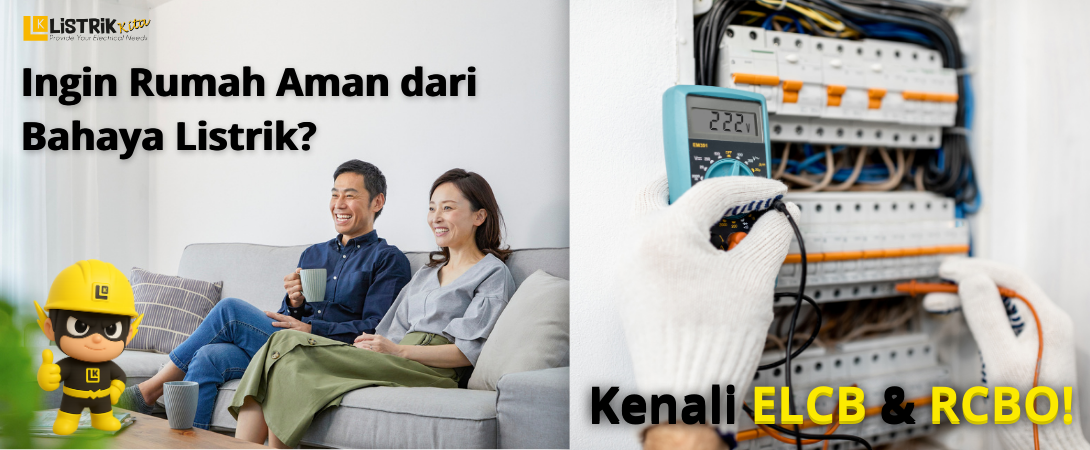
Home electrical safety should never be taken lightly. Current leakage, short circuits, or overloads can lead to serious consequences: from electric shocks to fires. To reduce these risks, proper protective devices are needed according to modern safety standards. Two common options are ELCB (Earth Leakage Circuit Breaker) and RCBO (Residual Current Breaker with Overcurrent Protection).
Many homeowners find it confusing to choose between ELCB and RCBO since both serve as protection devices. But what exactly is the difference between them? Let’s break it down.
Understanding ELCB (Earth Leakage Circuit Breaker)
What is an ELCB?
An ELCB is a safety device designed to detect leakage current to the ground (earth leakage). Its main purpose is to prevent electric shock and reduce the risk of fire caused by damaged cable insulation.
With an ELCB installed, you get extra protection because any leakage current is detected and stopped before it causes harm.
How Does an ELCB Work?
The working principle of an ELCB is simple:
-
When leakage current exceeds a set threshold (commonly 30 mA), the device automatically cuts off the power supply.
-
It mainly protects people from indirect electric shocks, for example when touching an appliance chassis that has become live due to a current leak.
In short, an ELCB adds an important safety layer that a regular MCB alone cannot provide.
Understanding RCBO (Residual Current Breaker with Overcurrent Protection)
What is an RCBO?
Unlike ELCB, an RCBO is an all-in-one protective device. It combines the role of an ELCB and an MCB. This means that in addition to detecting earth leakage, it also protects circuits from overload and short circuits.
In simple terms, an RCBO is a two-in-one solution for electrical safety.
How Does an RCBO Work?
An RCBO performs two protective functions at once:
-
Leakage protection (like an ELCB) – it trips when current leaks to the ground.
-
Overcurrent protection (like an MCB) – it trips when a circuit experiences overload or a short circuit.
This combination makes RCBOs practical, efficient, and a safer choice for modern installations.
Key Differences Between ELCB and RCBO
1. Function
-
ELCB: Only protects against earth leakage.
-
RCBO: Protects against both earth leakage and overcurrent.
2. Working Principle
-
ELCB: Compares the current flowing in and out. If there is a significant difference, the device trips. Older voltage-operated types detect voltage on the earth wire.
-
RCBO: Uses the same principle as modern current-operated ELCBs, plus a thermal-magnetic mechanism to detect overloads and short circuits.
3. Components and Installation
-
ELCB: Requires an additional MCB in the distribution panel, which takes up more space.
-
RCBO: Only one device per circuit, saving space and making the panel tidier.
4. Reliability
-
ELCB (especially voltage-operated types): Less reliable because its performance can fail if the grounding cable is broken or has high resistance.
-
RCBO: More reliable since it does not depend on the earth wire. It meets modern safety standards.
5. Application
-
ELCB: Still suitable for older installations or simple setups that already have MCBs.
-
RCBO: Highly recommended for new installations or renovations, especially in high-risk areas like bathrooms (water heater), kitchens, or circuits with heavy appliances.
Pros and Cons Summary
|
Aspect |
ELCB |
RCBO |
|
Advantages |
- Generally cheaper. - Suitable for upgrading old systems. |
- Dual protection (leakage + overcurrent). - Saves space in the distribution panel. - Safer and in line with modern standards. - Provides protection per circuit. |
|
Disadvantages |
- Only protects against earth leakage. - Needs a separate MCB. - Installation is less practical. - The old voltage-operated type is unreliable. |
- Higher cost per unit. - Installation can be more expensive if applied to all circuits. |
When compared, RCBO is clearly the superior option over a conventional ELCB. With dual protection against both leakage and overcurrent, it provides a higher level of safety and is more aligned with today’s standards.
Recommendations:
-
For new homes or major renovations, choose RCBO for practicality, safety, and space-saving benefits.
-
If the budget is limited, prioritize RCBO for high-risk circuits such as the kitchen, bathroom, or heavy-load appliances.
-
For older installations, combining ELCB + MCB is still an option, but make sure to use the safer current-operated type.
By choosing the right protective device, you can ensure that your home electrical system is safer, more reliable, and up to standard.
Find a wide range of ELCB and RCBO devices at Listrik Kita!
