


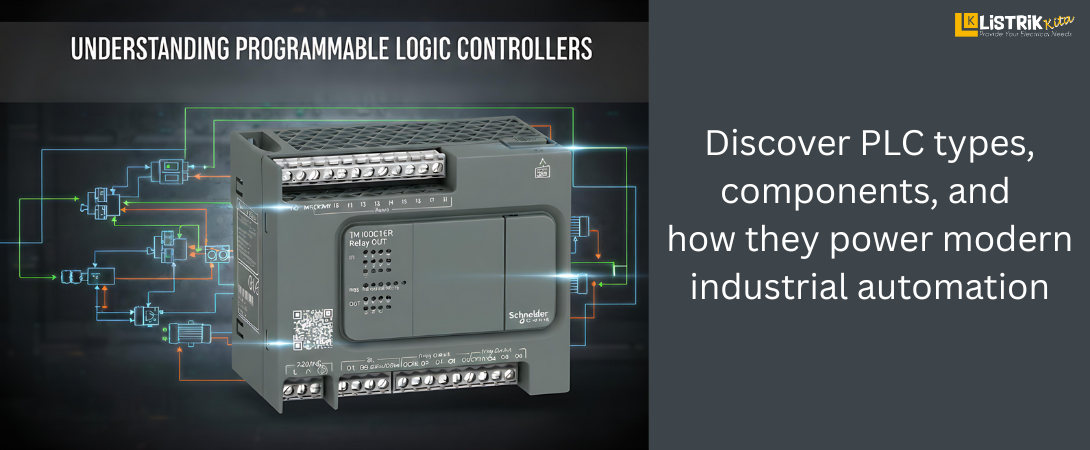
In today’s fast-paced, technology-driven industrial world, automation has become the key to efficiency and productivity. Almost every machine in a factory can now operate automatically, lifting, cutting, filling, and packaging products with precision and speed. Behind this advanced technology lies one vital device that acts as the brain of control systems: the Programmable Logic Controller (PLC). Without PLCs, modern industrial systems would not be as efficient or reliable as they are today.
What is a PLC?
A Programmable Logic Controller (PLC) is an industrial computer specifically designed to control manufacturing processes or automated machines. Unlike regular computers, PLCs are built to withstand harsh industrial environments such as high temperatures, vibration, dust, humidity, and electrical noise. They can operate continuously 24 hours a day and are easy to program according to industrial needs.
The main function of a PLC is to control machine operations automatically based on programmed logic. It receives signals from sensors, processes them through logic instructions, and then sends commands to output devices such as motors, lamps, or valves. In simple terms, a PLC serves as the bridge between the physical world and digital control systems.
Types of PLCs Based on Size and Capacity
Every automation system has different requirements. Therefore, PLCs are available in several types based on their size and the number of input/output (I/O) points they can handle.
1. Mini or Compact PLC
This type has a limited number of I/O points, usually fewer than 128. Its small size makes it suitable for single machines or simple systems such as small packaging equipment or automatic doors. Despite its compact design, it still provides high reliability and easy programming.
2. Modular PLC
A modular PLC consists of several separate modules such as the CPU, power supply, and I/O modules that can be arranged as needed. This design allows expansion in the future if more inputs or outputs are required. It is widely used in complex production lines that require high flexibility.
3. Rack-Type PLC
A rack-type PLC is a variant of the modular PLC, but all modules are mounted in a single rack. This setup provides a neat appearance, easy maintenance, and is ideal for large-scale systems such as chemical plants or automotive industries.
PLC Functions in Industrial Automation
PLCs play an essential role as the main control center in automation systems. Their functions can be categorized into general and specific roles.
General Functions
-
Replacing Conventional Relay Systems:
In the past, control systems used complex relay circuits that were difficult to modify. PLCs replaced them with flexible, programmable digital systems that are easier to change and maintain. -
Sequential Control:
PLCs can perform repetitive operations accurately and in sequence, such as in conveyor systems, packaging processes, or assembly robots. -
Process Monitoring:
PLCs monitor sensor and actuator status and send data to supervisory systems for analysis and reporting.
Specific Functions
-
PID Control (Proportional-Integral-Derivative):
PLCs can precisely control variables such as temperature, pressure, and flow using PID algorithms. -
Motion Control:
In industries that require accurate movements, such as robotics, PLCs are used to control servo and stepper motors. -
Data Acquisition and Communication:
Modern PLCs can collect production data and communicate with other systems such as HMI (Human Machine Interface), SCADA, or cloud-based platforms to support Industry 4.0 integration.
Main Components of a PLC
A PLC unit consists of several key components that work together as an integrated system.
-
CPU (Central Processing Unit):
The core of the PLC that runs programs, processes logic, and coordinates all modules. -
Memory:
Divided into Program Memory, which stores control logic such as Ladder Diagrams, and Data Memory, which stores input/output statuses and process variables. -
Power Supply:
Converts AC voltage (such as 220V) into low DC voltage (like 24VDC) needed by the CPU and I/O modules. -
Input/Output (I/O) Modules:
-
Input Module: Receives signals from sensors or switches and converts them into digital signals that the PLC can understand.
-
Output Module: Sends signals from the CPU to activate devices such as motors, lights, or solenoid valves.
-
-
Programming Device:
A computer or laptop with special software used to create, edit, and download programs into the PLC.
How a PLC Works: The Scan Cycle
A PLC operates using a Scan Cycle, which repeats continuously in milliseconds. This cycle includes three main steps:
-
Read Input: The PLC reads the status of all input devices and stores them in memory.
-
Execute Program: The CPU processes the control logic based on the input data.
-
Update Output: The results are used to control output devices.
Because this process happens very quickly, the system appears to respond in real time to changes in the field.
PLC Applications in Industry
PLCs are used in almost every industrial sector to improve efficiency and reliability.
-
Automotive Industry: Controls assembly robots for welding, fastening, or installing vehicle components.
-
Food and Beverage Industry: Manages mixing, filling, and packaging processes.
-
Conveyor and Warehousing Systems: Controls product movement and sorting automation.
-
Water and Waste Treatment: Operates pumps, valves, and chemical processes to maintain water quality.
-
Building Automation: Manages elevators, lighting, and HVAC systems for energy efficiency.
PLCs are the backbone of modern industrial automation. With their ability to operate continuously, adapt easily, and provide high reliability, they help industries achieve maximum efficiency, consistency, and safety.
Understanding the basics of how PLCs work is an important first step for anyone interested in automation and control systems. As digital technology advances and Industry 4.0 evolves, PLCs will continue to play a crucial role as intelligent controllers at the heart of future industrial systems.
Start using PLCs now to boost your machine productivity with Listrik Kita!
