


In today’s modern, electricity-driven world, inverters have become an essential part of electrical systems, both in industries and households. Before we explore their functions, let’s first understand what an inverter is and why it plays such an important role in everyday life.
What Is an Inverter?
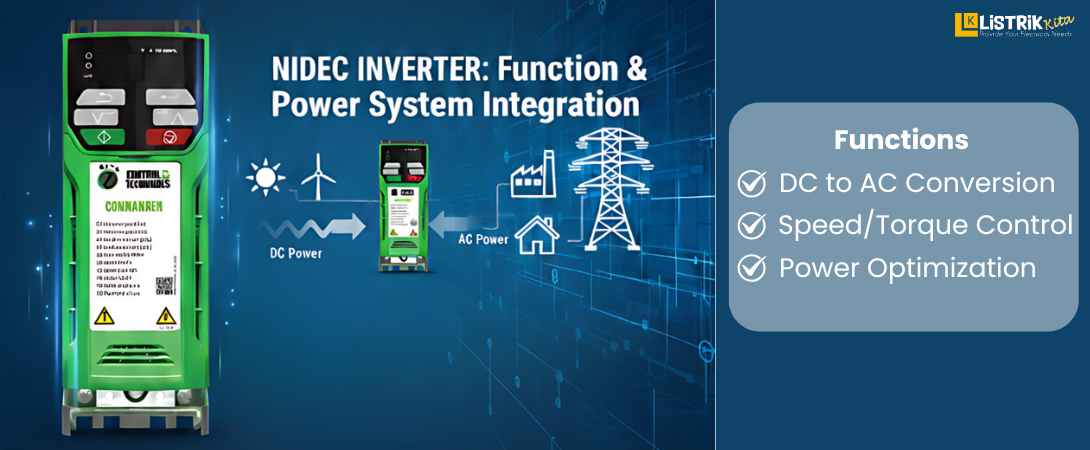
In simple terms, an inverter is an electronic device that converts direct current (DC) into alternating current (AC). Electrical energy stored in power sources such as batteries, car accumulators, or solar panels is typically in DC form. Meanwhile, most electrical appliances and industrial machines, such as refrigerators, air conditioners, motors, and factory equipment operate using AC power.
This is where the inverter becomes essential. It acts as a bridge that connects DC power sources with equipment that runs on AC. Without an inverter, energy from sources like solar panels could not be used directly to power household appliances or industrial machines.
Inverter Functions in Electric Machines: More Than Just Converting Current
Many people think that an inverter’s job is simply to convert DC to AC. In reality, its capabilities go far beyond that. Modern inverters are designed with advanced control systems that help boost efficiency, improve performance, and extend equipment lifespan.
Here are the eight main functions that make inverters such an important part of electrical systems:
1. Regulating Frequency and Voltage of AC Power
An inverter can control the frequency (Hz) and voltage (V) of AC output. This allows users to adjust the speed of electric motors as needed. For instance, in production lines, motor speed can be increased or decreased easily without replacing any mechanical parts. This flexibility is not possible when the motor receives power directly from the grid.
2. Improving Energy Efficiency
By precisely controlling motor speed and load, inverters can save up to 50% of energy compared to conventional systems. For example, in water pumps or industrial fans, the inverter reduces speed when the load is light, preventing unnecessary power consumption. This directly lowers electricity costs and improves overall efficiency.
3. Enhancing Machine Performance
Inverters allow smooth acceleration and deceleration of motors. This makes machines run more steadily without sudden jerks or vibrations. They also maintain torque at low speeds, ensuring consistent performance, a key factor in precision-based industrial applications.
4. Reducing Mechanical Stress and Wear
Because speed changes occur gradually, components such as bearings, belts, and gearboxes experience less stress. This leads to longer machine lifespan and lower maintenance costs. Over time, these benefits make a significant difference for industries operating heavy machinery continuously.
5. Optimizing Electric Vehicle Performance
In electric vehicles (EVs), the inverter serves as the “brain” that manages power flow from the DC battery to the AC motor. By efficiently controlling power distribution, it ensures maximum performance while conserving battery energy. As a result, the vehicle can travel farther on a single charge.
6. Providing Operational Flexibility
Inverters offer users the freedom to adjust motor speed and torque according to specific process requirements. For example, a conveyor belt in a factory can be sped up or slowed down easily through the inverter’s control panel. This flexibility enhances productivity without requiring mechanical modifications.
7. Supporting Renewable Energy Systems
In solar power systems (PV systems), the inverter is the key component that converts DC electricity from solar panels into AC for household use or for feeding into the power grid. This makes the inverter a cornerstone of green energy technology and sustainable energy development.
8. Maintaining Power Quality
Modern inverters come equipped with power factor correction (PFC) and harmonic filters to stabilize and clean the power supply. These features help reduce electrical noise, prevent system disturbances, and improve overall efficiency and reliability.
Applications of Inverters Across Various Fields
Thanks to their versatility, inverters are now used in almost every sector from factories to everyday home appliances.
Here are some common applications:
-
Industrial Sector: Conveyor drives, pumps, compressors, fans, and CNC machines.
-
Home Appliances: Energy-efficient AC units, inverter refrigerators, and washing machines.
-
Transportation: Core component in electric cars, trains, and ships.
-
Renewable Energy: Used in solar panel systems and wind turbines.
-
Building Infrastructure: Installed in elevators, escalators, and HVAC systems in offices and malls.
An inverter is no longer just a current converter, it has evolved into a smart power management device capable of controlling energy, improving efficiency, and supporting clean energy usage. In this era of electrification and digital transformation, understanding inverter functions is crucial.
By using inverter technology, both industries and households can achieve significant energy savings, better machine performance, and longer equipment life, all while contributing to a greener planet.
It’s clear that inverters are now one of the most important components shaping the future of modern electrical systems.
Find the right inverter for your needs — only at Listrik Kita!
