


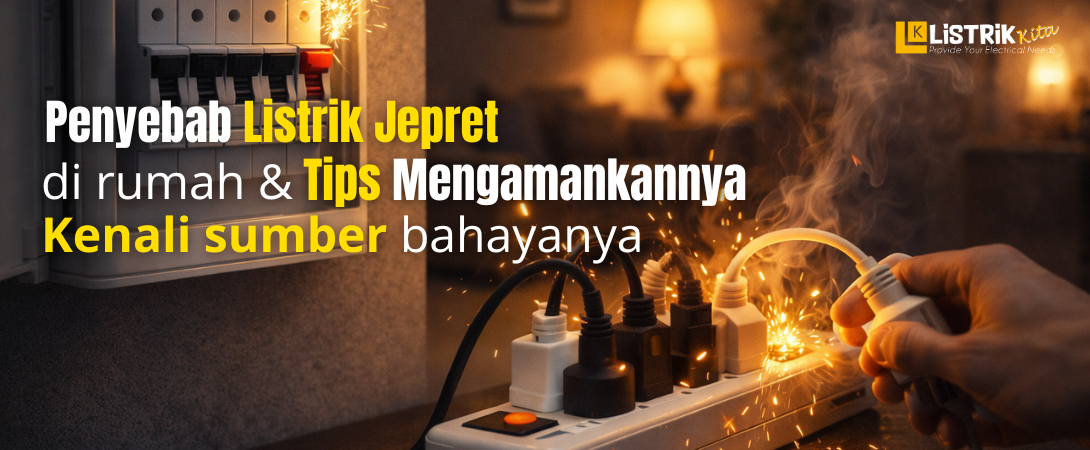
Have you ever been busy working on your computer, watching television, or cooking on an electric stove when suddenly all the power in your house goes out? This phenomenon, often called a "trip," is certainly very disruptive. However, behind that momentary interruption, a sudden power loss is actually an early warning system from your home's electrical installation. Understanding the various causes is not just about getting the lights back on, but more about maintaining safety and preventing more serious risks, such as fire.
This article will thoroughly explore the eight main factors causing frequent power outages, complete with in-depth explanations and practical steps to identify and address them.
Causes of Frequent Power Outages
Electricity that suddenly cuts off is generally triggered by a safety mechanism, primarily the MCB (Miniature Circuit Breaker), which works to cut the current. This disconnection occurs when the system detects a potentially dangerous anomaly. Here is a detailed explanation of each cause.
1. Electrical Load Exceeds Capacity
This is the most common cause. Every home has a power capacity installed by the utility company (for example, 900VA, 1300VA, or 2200VA), which also comes with a limit on the main MCB. When you turn on too many high-power appliances simultaneously like an AC unit, water heater, washing machine, and iron, the total power consumption will exceed the safe limit. The MCB then "trips" as an automatic response to prevent the cables from overheating and catching fire. Think of the MCB as a strict gatekeeper; when the electrical traffic gets too heavy, it closes the gate to prevent dangerous congestion.
2. A Short Circuit in an Appliance
A short circuit is a situation where the live (hot) wire and the neutral wire make direct contact without passing through a load (the appliance). This short contact causes a very large current to flow suddenly and drastically. The MCB will respond within seconds to break the circuit. Short circuits are often caused by damaged wire insulation inside an appliance, loose connections, or an appliance that has gotten wet. Sparks from a power outlet are often an early warning sign.
3. Damage to Electronic Appliances
Old or damaged electrical appliances can draw abnormal current. A seized motor, a broken compressor, or a leaking heating element can cause "earth leakage" or "overload" when switched on. Although it may not always cause a full short circuit, this condition is enough to trigger the MCB to trip. Appliances like an old refrigerator, water dispenser, or problematic oven are often silent suspects in these cases.
4. An MCB That is Damaged or Worn Out
MCBs themselves have a lifespan and can experience mechanical wear. If they trip frequently due to overload, their internal components can weaken. As a result, the MCB can become too sensitive (tripping often under normal load) or conversely, stop functioning (not tripping during an overload). Both conditions are equally dangerous and require replacement.
5. A Short Circuit in the Wiring Inside the Walls
This is a more serious problem than a short circuit in an appliance. A short circuit in the installation occurs in the network of cables embedded in the walls or in the electrical panel. Causes include rodent damage to cables, insulation stripped away by friction, high humidity, or poor initial installation quality. The telltale sign is that the MCB remains tripped even after all appliances are unplugged from their outlets.
6. MCB Capacity Does Not Match the Circuit Load
Errors in selecting MCBs are common. Installing an MCB with an Ampere (A) rating that is too low for a circuit will cause it to trip easily. Conversely, an MCB with a rating that is too high is dangerous because it will not cut the current during an overload, allowing the wires to overheat. Precise calculation is very important. For example, for a dedicated circuit for a 1 HP AC unit that requires about 1000 Watts, the MCB should be at least 6A (since 1000W/220V ≈ 4.5A, plus a safety factor).
7. Substandard Electrical Installation Quality
A haphazard installation using low-quality materials is a ticking time bomb. Using cables with a size (cross-section) too small for the current being carried, improper connections, or sloppy installation can increase resistance. This increase in resistance generates excessive heat (joule heating) which, over time, damages cable insulation and triggers problems, including sudden power outages.
8. The Installed Power Capacity from the Utility is No Longer Sufficient
This is the root problem on the supply side. The modern lifestyle with increasingly more electronic appliances (TVs, chargers, smart devices, etc.) often means the subscribed power capacity installed years ago (e.g., 900VA) is no longer adequate. Consequently, the main MCB at the utility meter will trip frequently, especially in the evening when all appliances are in use.
MCB is on but the power is out? Find out why here!
Diagnosis Steps and Preventive Actions
-
Observation and Isolation: Note which appliances were on when the power tripped. Try turning on high-power appliances one by one to identify the culprit.
-
Simple Test: Unplug all appliances, then reset the MCB. If the MCB stays on, the problem lies with one of the appliances. If the MCB trips again, the problem is within the house installation.
-
Power Needs Audit: Calculate the total power of your appliances and compare it with the utility's installed capacity. Consider applying for a power capacity upgrade if it is no longer sufficient.
-
Regular Inspection: Check the physical condition of power outlets, plugs, and extension cords. A burning smell or black marks are danger signs.
-
Professional Consultation: For issues with internal wiring, short circuits in walls, or panel replacement, always entrust the work to a competent electrical technician (with Electrical K3 Certification). Safety is paramount.
Ensure the MCB you buy meets SNI standards, comes from a trusted brand, and is installed according to the correct load calculation. For those of you looking for a solution to frequent power outage problems or wanting to upgrade your safety system, find a selection of quality MCBs with the right specifications for your home's needs only at Listrik Kita.
