


In the world of electricity, voltage surges and lightning strikes are serious risks that should not be ignored. A sudden surge can destroy electronic devices in seconds and may even trigger a fire. To avoid such losses, you need the right protection devices: Surge Arresters and Surge Protectors.
Although their names sound similar, these two devices serve different purposes, are installed in different locations, and provide different levels of protection. Understanding their differences is key to choosing the right solution for your home, office, or even large-scale industrial facilities.
What Is Surge Protection?
Definition and Purpose
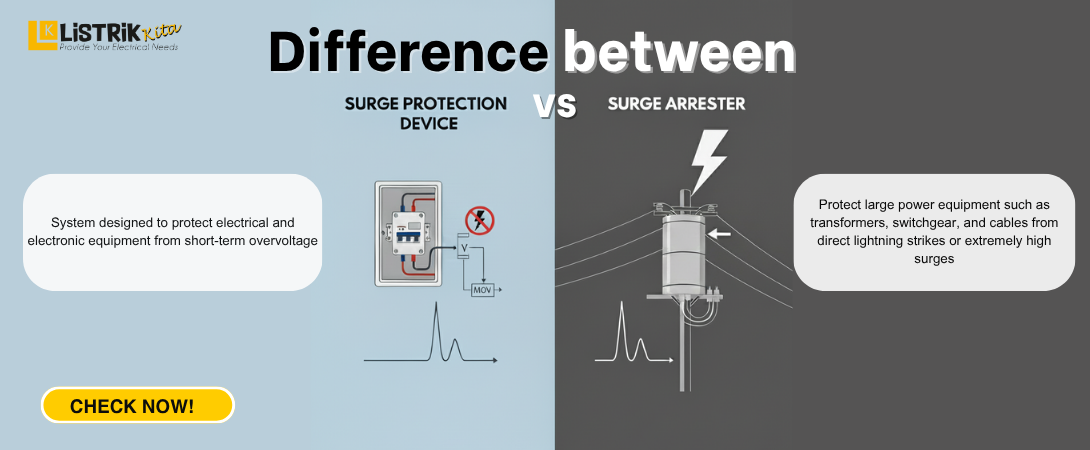
Surge protection refers to a system designed to protect electrical and electronic equipment from short-term overvoltage, also known as transient voltage.
-
External source: lightning strikes on the power grid.
-
Internal source: switching activities when turning on high-power appliances such as air conditioners, motors, or refrigerators.
The main purpose of surge protection is to divert or discharge excess voltage to the ground before it reaches the connected equipment. This keeps electrical devices safe and helps extend their lifespan.
Understanding Surge Arrester
Definition and Function
A Surge Arrester is typically used in medium to high-voltage power systems. It is commonly installed on utility distribution lines, substations, or main distribution panels in high-rise buildings. Its role is to protect large power equipment such as transformers, switchgear, and cables from direct lightning strikes or extremely high surges.
How a Surge Arrester Works
A surge arrester acts like a protective gate.
-
Under normal conditions: it behaves as an insulator.
-
During a surge: it instantly becomes a conductor, channeling the excess current straight into the ground.
-
After the surge: it returns to its insulating state without affecting the system.
Because of this, surge arresters are essential in large-scale electrical infrastructure.
Understanding Surge Protector
Definition and Function
A Surge Protector, also called a Surge Protective Device (SPD), is designed for everyday use. It is usually installed in wall outlets, power strips, or secondary distribution panels to protect sensitive household and office electronics such as computers, TVs, refrigerators, or network equipment.
How a Surge Protector Works
Surge protectors often use components like Metal Oxide Varistors (MOVs), Gas Discharge Tubes (GDTs), or diodes. These components clamp voltage spikes that exceed a safe threshold (for example, 330V) and redirect them to the ground.
This ensures that electronic devices continue to receive a safe level of voltage, while the excess energy is absorbed by the surge protector. Compared to surge arresters, surge protectors provide more refined protection, focusing on end-user devices.
Key Differences Between Surge Arrester and Surge Protector
1. Voltage Range and Application
-
Surge Arrester: used in medium to high-voltage systems, from thousands of volts to hundreds of kilovolts. Commonly applied in utilities, high-rise buildings, and heavy industries.
-
Surge Protector: designed for low-voltage systems under 1000V (typically 220V/110V). Suitable for homes, offices, and light industries.
2. Components and Current Capacity
-
Surge Arrester: built with zinc-oxide blocks, capable of handling surges up to tens of kiloamperes.
-
Surge Protector: uses MOVs, GDTs, or diodes that handle smaller surges, usually from a few hundred amperes to a few kiloamperes.
3. Installation Location
-
Surge Arrester: installed at the main entry point of the electrical system, such as on distribution poles, substations, transformer primaries, or main distribution panels. It serves as the primary shield.
-
Surge Protector: installed close to the devices being protected, such as at outlets, sub-panels, or integrated into power strips. It acts as the final safeguard.
Surge Protector: Where and Why to Use It?
Everyday Applications
-
At home: connect TVs, computers, smart refrigerators, or game consoles to outlets or stabilizers with surge protection.
-
At the office: install SPDs in distribution panels to safeguard servers, printers, computers, and communication systems.
Why It’s Important
Small, frequent surges can gradually wear down electronic components. A surge protector prevents this slow damage as well as sudden power spikes, making it an essential device in the digital age.
Surge Arrester: When Is It Critical?
Situations That Require Surge Arresters
-
High-rise buildings: installed at the main panel to protect the entire electrical system from lightning.
-
Factories and industries: protects expensive production machines from costly downtime.
-
Hospitals: ensures uninterrupted power supply for critical medical equipment.
-
Power substations and utility grids: the first layer of protection to maintain grid stability.
Why It Matters
Without surge arresters, a lightning strike could cause catastrophic failures such as transformer explosions, fires, and widespread power outages. The financial and operational losses are far greater than the cost of installing proper protection.
Surge Arresters and Surge Protectors are not competitors but complementary devices.
-
The Surge Arrester acts as the primary shield against large surges at the entry point of the system.
-
The Surge Protector serves as the final shield for electronic devices, filtering out residual or smaller surges.
If you live in a lightning-prone area or rely on valuable electronic equipment, the best strategy is to install both devices in layers. With a two-step defense system, your household appliances, office equipment, and even industrial infrastructure will remain protected from both major and minor power surges.
Protect your electronics today with reliable surge arresters and surge protectors from Listrik Kita.
